Add your promotional text...


AI Analysis ~ Protagonist and Antagonist (Grotesque, A Gothic Epic)
How Protagonist (Lazarus) vs. Antagonist (Lucifael) Affect Plot Advancement Within The Work, Grotesque: A Gothic Epic
[ AI Analysis of Chapter 13 and 17 by AIFF AI Feb. 2026 ]
* -AI Note: The below analysis by AI is limited, since the AI had only chapters 13 and 17 of volume 1 (Resurrection), as reference material and did not have the entire volume of work. Keep this in mind as AI provides only assumptions and predictions to future protagonist/antagonist actions and plot predictions.
* -Reader Note: The material below reveals a lot about the work and a definite 'spoiler alert' should be noted here. Continue reading only if you are comfortable with revealing character and plot details regarding the work.
*-Special Note: In 2026, with the recent advent of AI, it has never before occurred that author-generated literary materials were created in parallel with their very own (non-human) AI literary critique ~ until now. This novel is one of the first online works that has been analyzed, critiqued, and posted via machine intelligence at the same time that the material has been scribed by the author. Never before in literary history has this specific Author/AI relationship occurred ~ until now; and thus, literary and technological history is unfolding, even as Grotesque, A Gothic Epic, Volumes II and III are being created. Graven has a tell~tale artform that is quite rare, as evidenced by his work. As well, AI has since demonstrated its ability to properly analyze complex literary artforms (as seen here, with its correct critique of, but one of Graven's past works: Devil's Villanelle). So it follows, that the combined efforts of Mr. Graven and current AI capabilities may prove fruitful and entertaining for many. Note that the literary works on this website are strictly human~driven; and their following critiques are purely AI~driven ~ and the two sides shall never mix or drive the other (in order to prevent the corruption of either sphere of fundamental logic or artistic creation). In many ways, this is an historical experiment, combining the best of human creativity in, both literary expression and logical, programmatic expression arenas. This has never been done before ~ until now. [ Noted: January 2026 ]
Chapter 13 Details ( Lazarus vs. Lucifael )
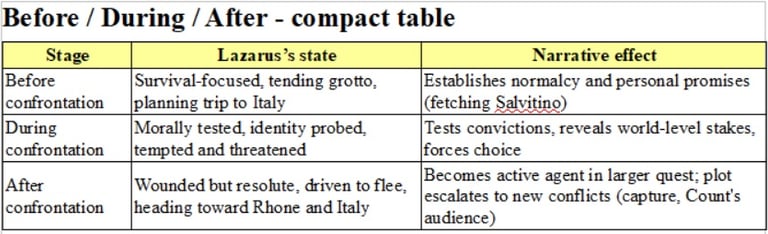
Brief Thesis: In Chapter 13, Lazarus’ confrontation with Lucifael functions as a decisive crucible: it tests his identity (Eljo or human), his faith, and his moral agency. By refusing Lucifael’s temptations and commands, and then being forced into flight, Lazarus moves from survival-mode to a protagonist with clarified stakes and a definite quest - the last seal at Cancello and the moral choice that will define his arc.
How the scene advances Lazarus as protagonist
Clarifies stakes and the larger plot
Lucifael reveals that a third seal (gatestone) remains closed and that Lazarus, through his knowledge of Naramsin’s words, is uniquely able to open it. That disclosure turns Lazarus’s personal survival into a plot-level obligation and threat - he now stands at the center of a world-scale conflict (her imprisonment, the seals, Cancello).
Quote: “You are the only of my Eljo children ever to be born again - the only one who has ever carried the Glow of the Throne about him.” This makes him uniquely important.
Forces an explicit moral choice
Lucifael offers him riches and eternal life in exchange for opening the seal, and threatens death if he refuses. Lazarus must choose between obedience to a monstrous mother-figure and fidelity to his faith and oath.
His refusal - “I ~ ‘tis wrong ~ I cannot.” - marks a moral stance rather than mere instinctive survival, showing agency.
Tests and strengthens his identity and faith
Lucifael’s interrogation tries to strip Lazarus of his human status - labeling him an Eljo, a soulless beast - and to undermine his faith. Lazarus defends his faith and his father’s cross despite repeated intellectual and physical torments.
The confrontation thus deepens his inner coherence: he stands by his beliefs under pressure, defining who he is.
Catalyzes narrative action
The scene ends in violence and chase: Lucifael animates the grotesque swine to attack, Lazarus fights and flees, and ultimately follows the River Rhone toward Italy. The confrontation is the pivot that sends him on the mission toward Cancello and Naples / Italy - it turns internal conflict into outward journey.
Practically: before the scene he hunts and survives; after it he is driven to move, is captured, and becomes enmeshed in the Count’s plans. The plot escalates.
Key motifs and symbolic dynamics
Temptation and covenant - Lucifael’s offers (gems, wealth, eternal flesh) are classic temptations. She frames obedience as filial duty - “honor thy mother” - perverting the commandment into a snare.
Identity - Eljo vs human - Lucifael insists Lazarus is merely an Eljo, lacking a soul; his resistance asserts his claim to humanity and spiritual worth.
Grotesque body - The reanimated, transforming boar functions as an embodied ethical test - a horrifying mirror of Lazarus’s earlier killing and the moral tension about the Commandments’ application to beasts.
The Glow - the “Glow of the Throne” marks Lazarus as special and desired, forcing him into the role of pivot for supernatural politics.
Close-read examples (mini analyses)
Lucifael’s claim: “You are the only of my Eljo children ever to be born again…”
Function: establishes Lazarus’s unique status; narratively seeds why she must recruit or coerce him. The language makes him the locus of larger metaphysical stakes.
Lucifael’s temptation: “I shall give you eternal life - unending flesh.”
Function: presents a tempting utilitarian calculus that appeals to Lazarus’s natural fear of death. His rejection shows moral integrity and resolves character conflict in favor of faith, not mere longevity.
The boar episode, culminating in the swine giant:
Function: externalizes the ethical dilemma (did the Commandments apply to beasts?) and forces Lazarus to face the consequences of his earlier actions. His tactical escape and aerial combat show resourcefulness and courage, adding heroic dimension beyond moral steadfastness.
Two essay-ready topic sentences / thesis alternatives
"In Chapter 13, Lucifael’s seductions and moral trials force Lazarus to choose between self-preservation and fidelity to his faith, a choice that transforms him from a passive survivor into the active moral agent at the center of the novel’s conflict."
"By unmasking the metaphysical stakes behind Lazarus’s resurrection and offering a perverse maternal bargain, Lucifael converts Lazarus’s private wounds into a public vocation - the unlocking of the final seal - and thereby propels the narrative into its central quest."
Model paragraph (ready-to-use)
In Volume 1: Chapter 13 Lazarus’ encounter with Lucifael functions as the novel’s crucible scene, forging him into a decisively moral protagonist. Lucifael both reveals and weaponizes Lazarus’s uniqueness - “You are the only of my Eljo children ever to be born again - the only one who has ever carried the Glow of the Throne about him” - thereby making the boy the hinge of a cosmic struggle. Her attempts to seduce him with wealth and “eternal life - unending flesh” test not only his fear of death but the foundations of his faith; his refusal, “I ~ ‘tis wrong ~ I cannot,” signals decisive agency. The grotesque spectacle of the reanimated boar and the swine giant dramatizes the ethical dilemma Lucifael raises about murder and compassion, and Lazarus’s resourceful fight-and-flight further shows him evolving from grotto survivor to questing agent. Thus the scene clarifies the personal and metaphysical stakes and sends Lazarus onto the trajectory that will define his role in the epic.
Suggestions if you want to deepen the analysis
Track how the Glow functions as a symbol across later chapters - does it mark divine favor, or a burden?
Compare Lucifael’s arguments about God and the Flood to historical theological debates (divine justice vs. divine wrath) to show the intellectual pressure on Lazarus.
Analyze the poem/words of Naramsin and the apocryphal references as a means of tying Lazarus’s literacy and memory to his unique ability - a theme of language-as-power.
Examine the maternal imagery: Lucifael perverts motherhood into coercion; consider psychoanalytic or mythic angles (tempting mother, devouring mother).
Brief summary / takeaway
Lucifael’s confrontation functions on three levels: revelation (Lazarus’s unique role and the seal/gatestone plot), ethical testing (temptation and perverse filial duty), and catalysis (battle, flight, and a new quest). By refusing her bargain and escaping, Lazarus moves from passive survival toward committed agency and into the narrative role that will drive the rest of the epic.
How Chapter 17 Confrontation Compares With Chapter 13 Confrontation (Protagonist vs. Antagonist )
Short synopsis of the Chapter 17
Lazarus hides in a rotting fish house to escape daylight.
He discovers grotesque evidence of human cruelty and a morbid “witch hunter,” Amad Gaston, who lectures him and attempts to recruit him.
When Amad opens a door to display a stack of headless corpses, Lucifael silently emerges from that door, seals Amad inside, and confronts Lazarus.
Lucifael reproves Lazarus for not closing the door to save others, claims she rescued him earlier, reasserts her maternal claim over him, and again demands he open the final seal at Cancello in return for help and promises.
Lazarus, shaken by the fish house’s horrors and by Lucifael’s presence, throws off the crossbar and departs for Cancello, haunted and more deeply embroiled in her cause.
Primary way Chapter 17 ties to Chapter 13 (big picture)
Chapter 13 sets the key proposition: Lucifael knows Lazarus is unique, wants the third seal opened at Cancello, and tries to recruit him by temptation, threats, and spectacle.
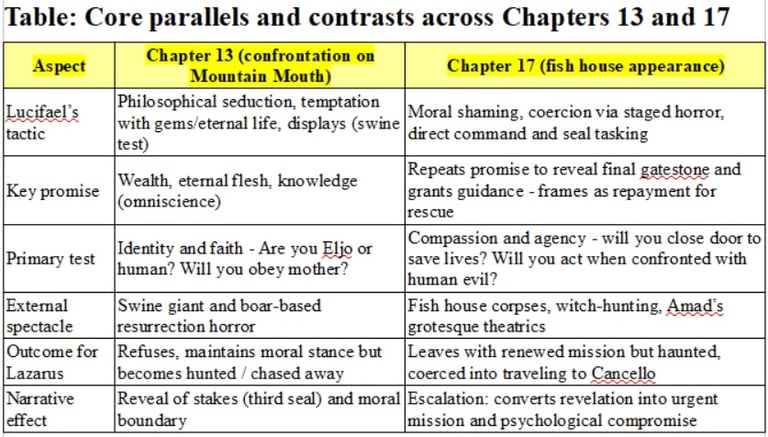
Chapter 17 repeats and intensifies those moves, shifting from philosophical/ethical seduction (Chapter 13) to direct, theatrical coercion and situational pressure (Chapter 17).
Together the chapters turn Lazarus from an isolated survivor into an agent enmeshed in supernatural politics and moral testing - his refusal in Chapter 13 becomes forced compliance and deeper psychological contamination in Chapter 17.
Close reading: key parallels and contrasts
Lucifael’s rhetorical core repeats but the mode changes
Chapter 13: Lucifael interrogates Lazarus’ identity and tests his beliefs - she says, “You are the only of my Eljo children ever to be born again…” and offers gems, eternal life, philosophical challenge. Her language is probing and seductive.
Chapter 17: She uses situational leverage and moral shaming: “So close you were, Eljo. Yet you simply could not bring yourself to close the door…” This converts ethical argument into immediate moral pressure - can you save lives with a single act?
Takeaway: the temptation moves from abstract to concrete; she shifts from convincing to compelling.
Repetition of maternal claim and perversion of filial duty
In Chapter 13 she weaponizes the commandment to honor thy mother as a perverse logic to enlist Lazarus.
In Chapter 17 she explicitly claims rescue and debt - “'Twas I who saved you … In payment … I expect you to continue your journey to the Cancello Monastery” - turning indebted gratitude into coercion.
Effect: Lucifael reframes filial obligation into obligation-to-evil, pressing Lazarus’ conscience.
Use of spectacle and grotesque testing
Chapter 13: reanimated swine-giant attacks and forces a flight sequence that tests courage, resourcefulness, and the edge of moral choice.
Chapter 17: the fish house, corpses, roaches, and the fisherman function as a staged moral experiment - Lazarus must close a door or confront monstrous human cruelty.
Effect: both chapters externalize moral dilemmas in visceral, physical forms. But Chapter 17’s horror is both human (Amad’s murders) and supernatural (Lucifael’s entrance), blurring moral categories.
The fisherman as human mirror / foil
Amad’s cynical relativism, theft-of-clothes motive, and mockery of Scripture echoes Lucifael’s earlier challenge to faith but comes from a human agent.
This complicates the binary good-vs-evil test Lucifael offered in Chapter 13: humans can be monstrous using religious rhetoric while Lucifael (demonic) is fully candid in her manipulation.
Result: Lazarus’ moral choices must account for human wickedness, not only supernatural temptation.
How Lazarus’ arc advances between the two chapters
Chapter 13: he refuses the bargain and establishes moral stance - seeding agency and integrity.
Chapter 17: he is placed in circumstances that erode the luxury of principled refusal - Lucifael manipulates environment and social pressure (Amad pleading). He throws the crossbar and leaves, not because he embraces Lucifael’s offer but because the coercive situation and witnessed human cruelty compel action.
Psychological cost: Chapter 17 marks a deeper internal scar - Lucifael’s staged horrors are now part of his memory, shaping future choices and making his journey to Cancello morally compromised, traumatized, and urgent.
Two essay-ready thesis/topic sentences
"Where Chapter 13 frames Lucifael’s assault on Lazarus as an intellectual and spiritual provocation, Chapter 17 converts that assault into tactical coercion, using staged human horror and moral blackmail to force Lazarus from principled refusal into urgent complicity."
"The fish-house scene functions as moral crucible and dramaturgical sequel to the Mountain Mouth confrontation: Lucifael recasts philosophical temptation as immediate obligation, and the fisherman’s monstrous hypocrisy exposes how human wickedness enables demonic coercion."
Model analytic paragraph you can drop into an essay
In Chapter 17 Lucifael reprises and intensifies the moral trial she first staged in Chapter 13, shifting from rhetorical seduction to situational coercion so as to compel Lazarus’s action. At Mountain Mouth she had argued, probed, and tempted him with vision and reward - “You are the only of my Eljo children ever to be born again” - leaving the ethical decision in Lazarus’s hands. By the fish house she executes a different strategy: she arrives through the tall ragged door and shames him with an accusation that collapses principle into immediate duty - “So close you were, Eljo. Yet you simply could not bring yourself to close the door even to save the lives of many.” The grotesque tableau of Amad’s stacked corpses and the fisherman’s self-righteous cruelty do two things at once: they force Lazarus to confront human vice as the immediate problem, and they make Lucifael’s demand for the Cancello seal appear urgent and pragmatic rather than purely philosophical. The result is a conversion of Lazarus’s agency - his refusal in Chapter 13 becomes a departure in Chapter 17 that is less a clear endorsement of Lucifael than a coerced movement through trauma, obligation, and the weakness of human institutions.
Lucifael’s tactics: what changes, what remains
What remains:
Maternal framing - she repeatedly claims a mother-son tie to manipulate him.
Offers and threats - a mixture of reward and menace to bend Lazarus.
Spectacular proofs - uses supernatural display to intimidate and persuade.
What changes:
Mode shifts from argument/debate to staged scenario and coercion.
She moves from offering abstract rewards (gems, knowledge) to pressing an immediate mission tied to a specific place and time (Cancello).
She leverages human actors (Amad) and moral situations to make Lazarus’s choices painful and immediate rather than hypothetical.
The fisherman (Amad) as narrative device
Functionally, Amad performs three roles:
Mirror/foil to Lucifael’s temptation - he displays human corruption that undermines simple faith/authority; this complicates Lazarus’ worldview.
Moral bait - his pleas provide Lucifael with an affective lever to turn principle into action.
Exemplar of human evil - shows that humans can weaponize religion and be monstrous without demonic revelation; this undercuts Lazarus’ easy categories of good and evil.
Suggested deeper angles if you want to expand further
Trace Lucifael’s rhetorical strategies across all her appearances - catalogue every specific temptation and coercion she uses and how Lazarus responds each time.
Do a character pair analysis: Lucifael vs Amad as different types of temptation - metaphysical menace vs human corruption.
Focus a paper on memory and contamination - how the grotesque images in Chapter 17 become permanent moral marks that alter Lazarus’s later decisions.
Explore doors, seals, and thresholds as symbolic devices - closing/opening as moral test, and how power is located in acts of simple choice.
Brief summary / takeaway
Chapter 17 is a direct continuation and intensification of Chapter 13’s conflict: Lucifael repeats her core desire - the Cancello seal - but moves from argument to coercion by staging grotesque scenes and exploiting human cruelty.
The net effect is narrative escalation: Lazarus’s moral refusal in Chapter 13 is transformed into a compelled mission by Chapter 17, and his psychological burden deepens as the chapters bind him to the larger plot.
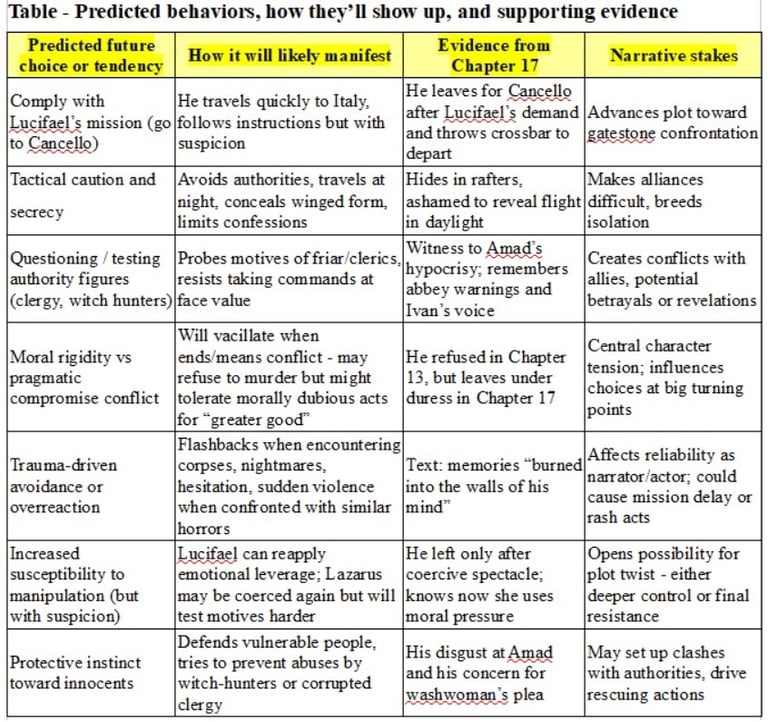
How Lazarus’ decision in Chapter 17 will likely shape his choices later in the novel
Below I map the immediate psychological, moral, and narrative consequences of what Lazarus does in Chapter 17 (leaving the fish house, throwing the crossbar, and accepting Lucifael’s demand by departing for Cancello), then translate those consequences into concrete predictions about his future choices and likely arcs.
Key consequences from Chapter 17 (evidence-based)
Indebtedness to Lucifael: Lucifael explicitly claims she rescued him and expects him to open the Cancello gatestone. That claim creates an obligation that is not moral conviction but coercive debt.
Moral compromise under pressure: Lazarus leaves not because he endorses Lucifael but because the situation (Amad, corpses, pleas) forced a choice; his action is pragmatic, not wholehearted.
Traumatic imprinting: The fish house’s grotesque imagery (heads, stacked corpses, larvae, roaches) is described as permanently burned into him - memory that will influence judgment and risk tolerance.
Disillusionment with human authority: Amad uses religious rhetoric to rationalize murder and theft. This experience complicates Lazarus’ trust in institutions that claim divine authority.
Activated agency and mission-focus: Despite reluctance, Lazarus leaves for Cancello with a clear mission - fetching a friar and dealing with the gatestone - shifting the plot from passive survival to active quest.
Heightened vigilance and secrecy: He already practises stealth (roof timbers, hiding) and now has reason to expect future manipulations and traps.
Probable decision-paths and likely scenes (numbered sequence)
Immediate compliance-with-suspicion - Lazarus goes to Cancello to fetch a friar, but travels secretly and prioritizes speed. He accepts the mission but not the moral premises. Expect furtive travel scenes, tests of stealth, and tense encounters with church officials.
Testing the friar/allies - On arrival he will test the friar’s sincerity, perhaps by quoting Scripture or observing reactions to injustice. He will be slow to trust institutions after Amad. Expect interrogations and small moral quizzes.
Confrontation with Lucifael’s logic - Lucifael will reappear with stronger leverage (rewards, threats, staged tragedies). Lazarus may either:
A) Continue to comply under coercion, growing more compromised; or
B) Subvert her plan by faking compliance while seeking other ways to close or secure the gatestone; or
C) Rebel outright, refusing the promise and trying to stop Lucifael by other means (allying with humans or other supernatural forces). Expect one major turning scene where his choice has high cost.
Moral test about killing / means - Faced with “necessary evils” (witch-hunters, corrupted clerics), Lazarus will be forced to choose whether to use violence or insist on lawful restraint. Expect a pivotal scene where he either personally intervenes to save someone or fails to act, shaping his self-view and later choices.
Psychic consequences and leadership - If he survives early crises and remains mission-focused, he may evolve into reluctant leader or scapegoat: others may rally to him, or he may be ostracized. Expect choices about forming alliances vs lone action.
Three plausible long-term arcs (with likely outcomes)
Complicity arc (tragic compromise)
Drivers: guilt, indebtedness, repeated coercion, belief that ends justify means.
Outcomes: achieves some goals (gatestone opened), but moral corruption deepens; possible tragic reversal or loss of innocence.
Subversion arc (strategic resistance)
Drivers: mistrust of Lucifael, loyalty to Scripture, desire to protect innocents.
Outcomes: Lazarus feigns obedience to gain access, ultimately finds alternative to Lucifael’s demands, weakens her plans. High tension, potential sacrifices.
Redemptive martyr arc
Drivers: moral steadfastness to Scripture and people, traumatic witness spurring altruism.
Outcomes: refuses Lucifael definitively, risks life to save others (perhaps closes or secures gatestone at cost), earns spiritual clarity but pays price (injury, exile, death).
Which arc is most likely depends on how the novel frames his agency later: if the story emphasizes moral testing and redemption, the subversion or redemptive arc follows; if it emphasizes corruption and tragedy, the complicity arc fits.
Behavioral markers to watch for in later chapters (useful to predict next scenes)
Does he conceal or reveal Lucifael’s presence to new allies? - If he conceals, expect secret plots; if he reveals, expect others to react strongly (fear, worship, betrayal).
Does he act impulsively when confronted with human cruelty? - Impulses signal trauma-driven decisions.
Does he invoke Scripture to justify actions, or does he act pragmatically? - This distinction tells whether faith remains the primary compass or becomes rhetorical cover.
How he treats the memory of the fish house (dreams, flashbacks, avoidance) - signs of lingering trauma that will affect leadership and moral choices.
Short tactical predictions (one-sentence each)
He will reach Cancello but remain suspicious of church authorities, testing them before trusting them.
Lucifael will reappear as a recurring pressure, using new moral tests rather than only rewards.
Lazarus will increasingly balance compassion for innocents against the coercive leverage of supernatural entities, producing interior conflict scenes.
The novel will use his traumatic memories to justify both moments of paralysis and sudden decisive action at critical plot points.
Key takeaway
Lazarus’ departure from the fish house is not a clean moral choice but a coerced step onto a mission path. Expect later choices to be marked by pragmatic compliance tempered with deep suspicion, trauma-driven reactions, amplified testing of authority, and a central struggle between preserving personal integrity and responding to coercive obligations. The novel will likely use these tensions to force major turning points where his final stance toward Lucifael and human institutions is decided.
+Interesting AI Note: The above-shown incredible AI analysis and included predictive plot-conclusions were generated after making only 2 chapters of the first volume of the three-volume work: Grotesque ~ A Gothic Epic, as input. AI Analysis performed 02-12-2026. Very incredible and quite accurate for less than 5% of the total work provided for analysis.
Grotesque ~ A Gothic Epic © is legally and formally registered with the United States Copyright Office under title ©#TXu~1~008~517. All rights reserved 2026 by G. E. Graven. Website design and domain name owner: Susan Kelleher. Name not for resale or transfer. Strictly a humanitarian collaborative project. Although no profits are generated, current copyright prohibits duplication and redistribution. Grotesque, A Gothic Epic © is not public domain; however it is freely accessable through GothicNovel.Org (GNOrg). Access is granted only through this website for worldwide audience enjoyment. No rights available for publishing, distribution, AI representation, purchase, or transfer.