Add your promotional text...



Gatestone Translation Scrolls
Volume 1: Chapter 1 ~ The First Seal | Grotesque ~ A Gothic Epic | G.E. Graven


Awash in a still mist, the mountain forest seemed a perfect Eden. Clamorous birds fluttered in the canopy, and morning sun bled through the treetops, casting shards of slanted light through the haze. Ever so often, the mist parted for a wandering animal inspecting roots and grubs, only to swallow the creature up once again and become what it had been, an unbroken diaphanous wall. A single leaf spiraled lazily through shafts of sunlight, disappearing into the mist. Another leaf trailed the first, then another. The birds fell silent.
And so it began.
The mist began to churn with fleeing wildlife, and leaves, twigs and feathers rained from the trees as flocks of bright birds erupted skyward. The mountains rumbled and trees swayed as the earth tolled like a struck gong. At the peak of that ominous tolling, a stampede of hideous winged beings came surging over the mountain crest. Some, Cyclops, towered tall as trees. Others, chimera-like stood no taller than might a human child. All wore battle dress, their membranous wings flailing in agitation, claws clutching swords and shields. By the thousands, the host of angels, giants, and grotesques, who were the Grigori, Nephilim, Eljo, Gorgon, Titans, and Cyclops, poured down the mountainside together as one ~ a cascading avalanche of ruin. In the forefront of the roaring blaze, a band of angels with wholly black eyes led the descending multitude into the shadowed valley, carving a wide swath along the slope and pressing the forest flat. No living thing remained standing in the wake of that unholy legion. Then, as hastily as it arrived, the pandemonium vanished.
A new silence overwhelmed the ravished landscape, as complete as the devastation of only moments before. At length, the gong resounded as the earth began to groan with the passage of a second multitude. Across the mountain now came another legion of angels, clad much the same as the first horde, but unlike enough to warrant being classified as an entirely different species. These creatures resembled large men and women rather than demons; and though their eyes were equally black, they were more intent than incensed.
The host of creatures paused on the summit of the mountain, surveying the devastation below. The lead angel, Michael, turned and spoke in a voice like a choir of thousands. "A deception is woven here ~ they remain!" Turning back to the seemingly abandoned slope below, he bellowed, "Semjaza, you shall have no peace! Undo your incantation! Cerberus! Araqiel!" There was no reply. "Show yourselves! By command of the Throne!" the angel roared.
Two more legions of angels descended from the skies, their numbers nearly blotting out the sun before lighting amongst Michael’s formation. These were the hosts of Gabriel and Raphael. Michael addressed them, saying, "Semjaza and his legions are below. Cerberus has betrayed us as well, since aligning his ranks with those of ~"
Abruptly, a fallen tree became the angel Araqiel, revealing her true form even as she hurled toward Michael.
"Michael!" Raphael warned.
Michael spun and thrust his sword in the air in a single movement. Araqiel came down on it, swiping at him with her sword and screeching even as his blade impaled her. She crashed to the ground and exploded into an angry swarm of dissolving dust flecks. "Semjaza!" Michael shouted. "Your deception shan’t exclude you from judgment." He stepped into a clearing. "Another gate shall be here," Michael exclaimed, thrusting his sword into the ground. Again, the mountain shook as Michael withdrew the brilliant blade, blood now spewing from a wounded earth.
A scream rent the air, and what had appeared to be a boulder became the stumbling figure of Semjaza, clutching a gaping wound in his chest. "Cerberus!" He cried. "Break the sword! Close the wound!" As Semjaza fell, his spell broke and the landscape transformed. Where fallen trees and boulders had lain in disarray, now the legion of demons stood revealed ~ thousands of them ~ crouching on the ravaged mountainside. Instantly, one of them blazed upward along the slope of the mountain: a horrid angel with three dog-like heads, gnashing teeth and the whipping tail of a serpent ~ Cerberus. Winds gathered with tempest force, and clouds roiled in a quickly darkening sky.
"Ezequeel!" Semjaza cried. "The clouds! Break the sword!" Semjaza then rolled a brief distance, died, and burst into a cloud of dust. The host of Semjaza lunged forth in attack, following Cerberus up the mountainside toward Michael. Calmly, the three legions atop the mountain moved back, knelt and bowed their heads. A black vortex descended from whirling clouds, falling toward the earth. The ground heaved, and a rock rose from the bleeding wound Michael's sword had made. The vortex enveloped the rough stone and scoured it black, shaping and inscribing the stone in a fury of motion. From the chaos emerged a polished rectangle, etched upon its five surfaces with hundreds of rows of intricate circular and linear symbols.
The emerging monolith turned Cerberus' advance to a rout. The attacking legion turned as one and tore back down the mountain, terror replacing the blood lust in their black eyes, but it was too late. The gate was complete. The fleeing angels slowed as though the air had turned viscous, slowed and then stopped even as they fought to escape. The whirlwind sucked at them, dragging them inexorably to its heart until each one had been swallowed by the monolith. When the last had disappeared, the heart of the monolith burned away, leaving a gaping hole through its center. The vortex ascended into the heavens and the clouds slowed their spin. In the silence, the angels could hear the hiss of steam rising from the new~made gate.
The smooth black monolith stood seven feet high by five feet wide by three feet deep, every visible inch of it covered with verses in the language of angels and of God Himself. The glassy black surface of the monolith was as perfectly smooth as the best mirror, and the center hole was flawless in its shape, two feet across and gutting the stone widthwise. The stone seal was perfection.
The kneeling angels rose. Michael turned to Gabriel. "The remaining Watchers are cloaked in the hills of Uhr." Gabriel stroked his sword and moved up the mountainside. "Gabriel," Michael called after him.
Gabriel glanced over his shoulder without breaking stride, as Michael added, "They must be slain by their own swords ~ by command of the Throne." Gabriel waved a reply of affirmation, leapt atop a large stone, and bellowed over the heads of his legion, "To the valley of Uhr! To the last Grigori! No swords!" Gabriel blazed toward the western horizon with his legion tightly in toe.
"And where has Azazel fled, Michael?" Raphael inquired with a voice of many.
"He has flown into the desert mountains of Haradan," Michael answered. "He has sworn an alliance with Lucifael. Azazal supports her claim to the Throne in exchange for protection in her greater numbers." Michael inspected the hissing monolith. The two of them circled the stone seal as Michael continued, "And Batarel's many legions soon fill her ranks." Michael stopped short and cut an eye to Raphael, his brow carved with concern, "If they unite, then Lucifael acquires the numbers she needs. The Nephilim also stand behind her; and she desires the Throne ~ above all else."
Raphael turned and bellowed over his vast heavenly ranks of swords and wings, "We move against Batarel and the Nephilim hoard! Ready yourselves!" Half of the angels tore into the eastern heavens, closing aerial ranks behind Raphael.
Michael then commanded of the remainder, "Align ourselves for strikes against Lucifael's new legions! She expects us; yet the Throne is with us! As in every strike, we split away the giants and earthly damons before swarming their middle ranks. Move as one with me; and tarry not!" A cloud of white wings and glistening armor exploded into the skies behind Michael, abandoning the standing seal.
And so the seal stood for nearly six hundred centuries, long since concealed by the elements and time as dust settled upon it, and then layers of dirt and rock. Encrusted within the Asian continent, it lay dormant as the decades chased one another like mating Chinese mayflies.
With the fall of the Watchers and the Grigori, those angels who looked after earthly affairs, only Man remained to oversee the good earth. And He did for many generations. Then, whilst tending His gardens, Man happened to discover the buried gate. Knowing it to be of divine origin, He cleared away the centuries and enshrined it, constructing a temple around it. For half a millennia more, He kept the artifact secret, worshiped it and fashioned His life around it ~ until the day came when He became learned enough to open the seal and yet remained foolish enough to attempt it.
~*~
Central China ~ June, 1331
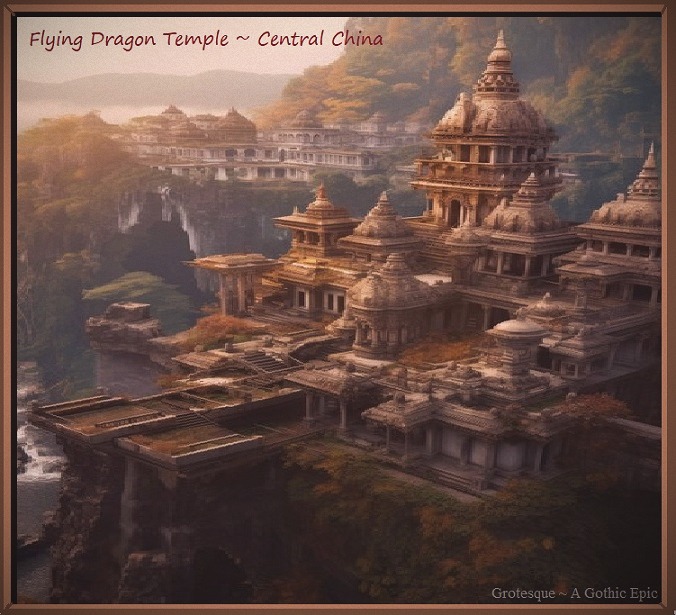
Hundreds of pigeons lined the massive roof of an ornate Chinese temple, clucking and pecking one another as they sought to lay claim to more of the sparse ledge space. Again and again, a single bird fluttered from the congested ridge, circled wide, and rejoined the throng, disappearing into the mass. Below the ledge, decades of pigeon excrement had streaked the stone surfaces gray and white. Statues of stone perched atop evenly spaced platforms protruded from the pigeon shelf. Each depicted a grotesque stone beast, four feet high and with membranous, bat~like wings.
Some of these stone beasts were dragon-like, others part man and part beast, and still others were humanoid but primitive in appearance. Some crouched with wings splayed, some with wings tucked and folded, and then there existed various combinations of the two. Details of the statues and their random posture were so lifelike that they might have been living creatures frozen in stone. They thrust outward in all directions, lining the entire top of the temple.
The temple itself was notably ancient, comprised of irregular stone slabs hewn a thousand years earlier. Eroded engravings depicting flying demons covered the outer walls of the structure, the most plentiful an icon of a dragon with splayed wings and wholly enclosed by three circles that shared a common center. Three arched entrances lined the temple face, the center arch standing higher than did those on either side of it. Three eight-foot stone carvings of winged lion~like beasts guarded the left edge of each of the arches, and engraved above each of the three arches was a distinct Chinese inscription. Altogether, read right to left, the completed passage could be rendered: ‘Flying Dragon Temple.’


Manicured gardens surrounded the temple as humped teak bridges bowed back and forth across a slithering brook. Beyond the bonsai trees and boulders of the inner garden, orchards of fruit and nut trees and small groves of hardwoods gave way to wilder mountain forests. On the fringe of those arranged gardens and untamed woods, a China thrush perched in an ancient, native ginko tree, filling the air with tranquil tones whilst midmorning sunlight dappled paths and pools.
A row of black-robed monks snaked from the forest, moving solemnly down the stone walkway leading to the building. They drifted like mist down the path with lowered heads and hands clasped before them. They filed silent as death into the temple. Inside, countless candles burned on every horizontal surface, and the sweet smoke of incense spiraled from perforated canisters. Candles and incense combined to lend a thick air of spirituality to the atmosphere inside the temple walls. The silken monks moved through three consecutive chambers, each chamber larger than the one before it. The last of these was vast and its concave ceiling reached high above the priests. Etchings of flying beasts encircled the dome of the ceiling. Countless intersecting lines and inscriptions marked its curved surface, appearing much like a detailed astrological map of the heavens.
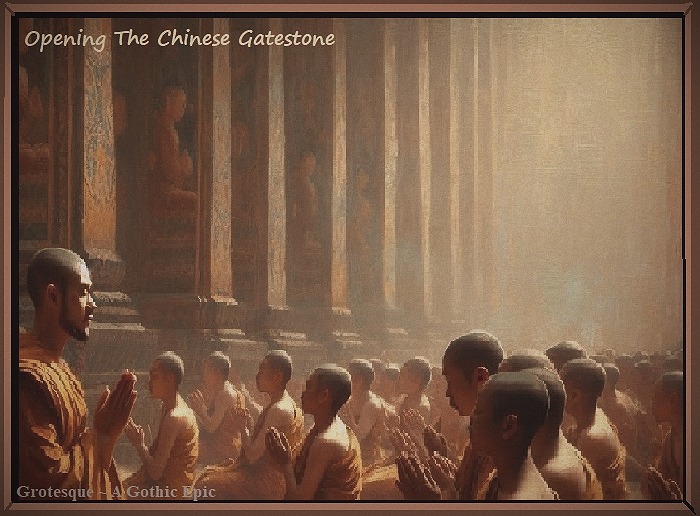
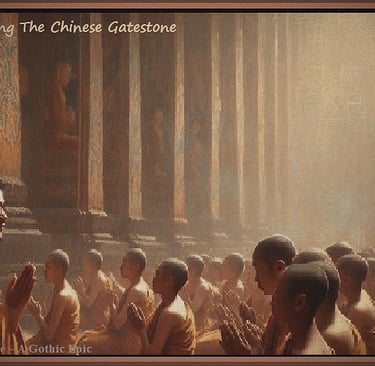
A perfectly symmetrical round hole had been cut into the polished floor in the center of the room. The pit was large, nearly thirteen feet deep. Like the floor of the temple, the cylindrical wall of the hole was smooth and polished, and in the center of the hole, fifteen feet below the temple floor, stood the stone seal. Even with the passing of sixty thousand years, the gatestone stood flawless and unspoiled as the day it swallowed the Watchers and a great part of the heavens.
Four emaciated priests sat near the edge of the pit hole, with their legs folded and their robes pulled away from their shoulders to reveal narrow chests and thin arms, their decrepit condition evidence of long periods of fasting. Sweat glistened on their necks and ribcages, and their eyes burned in the bottoms of sunken sockets as they sat like statues, deep in meditation. The procession of monks circled the four priests, then seated themselves shoulder~to~shoulder to form a solid wall around the priests and the pit. As more monks arrived, they formed a second circle, and then a third, until three concentric rings of meditating holy men filled the chamber. In the deep silence, the occasional guttering of burning candles echoed softly through the dome as the sounds of far away thunder.
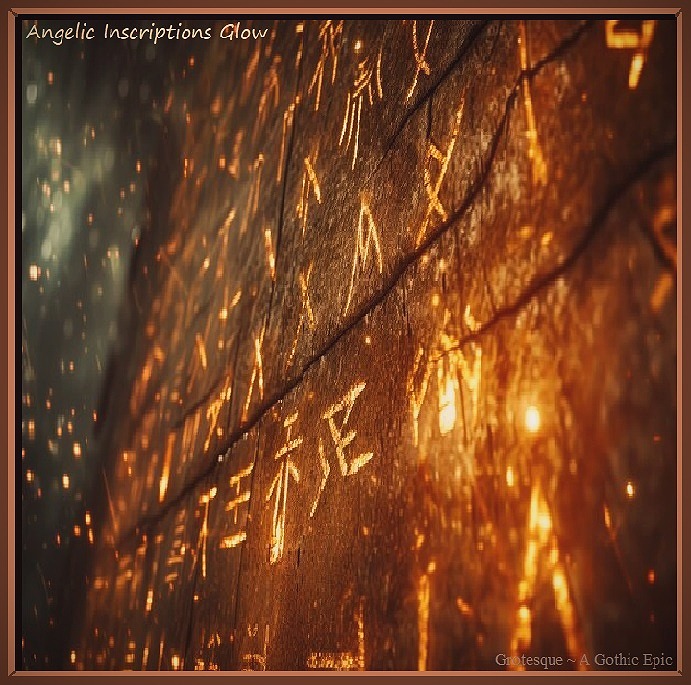
Soon three more priests entered the area. Two carried large candles and the third walked between them, this one garbed in robes as red as fresh blood. He carried an ancient, scrolled parchment in his hands. The three priests stopped behind the circle of monks, and the priest in red unrolled the scroll, revealing columns of Chinese writing. The parchment contained translations of the verses that were inscribed on the surfaces of the gatestone.
Outside the temple, around its grounds, the only sound was the gurgling of the placid stream. The thrush took sudden flight, chasing a bee through the garden flowers. As the beak of the songbird snapped the bee from the air, there was an explosion, and instantly the dome of the temple shattered, sending stone shards hundreds of feet into the air. The concussion was so fierce that it stripped the nearest trees naked of their leaves and fragments of granite stone and human bone impaled their seared trunks. Enormous chunks of stone hailed down into the garden, snapping branches and pressing craters into the neatly raked earth. Billowing dust and ash raced over the grounds and rolled down the entire mountainside like a hyperactive pyroclastic cloud.
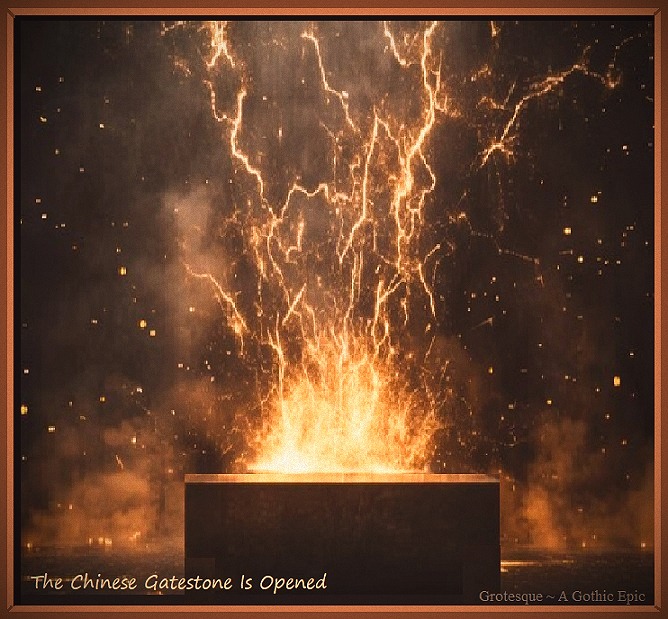
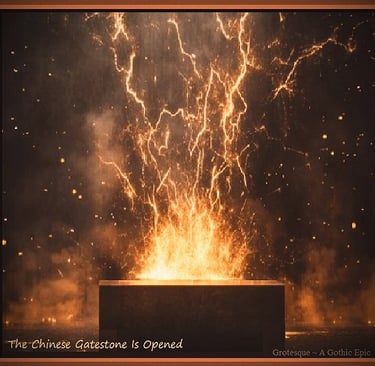
What was left of the temple glowed with furious heat, cracking the stones left standing. And still, the temperature climbed, until the sides of the smooth pit at the epicenter of the temple liquefied like seeping sap. The seared trees surrounding the temple burst into flame. The unscathed gatestone stood out from the center of the crater. The hole at the heart of the stone turned thickly opaque with a bilious black fog, which began to roil and fume, spilling out of the gatestone like a viscous caustic cloud dense as sulfurous gases.
The cloud rose from the crater and hugged the ground whilst it drifted beneath the lighter ash. It did not dissipate, but remained collected as a single boiling mass, blighting the garden greenery in its wake. Then, in an unscathed clearing, it stopped and churned in place for but a moment before rolling in upon itself and coalescing at its center. Arcs of light resembling a thunderstorm in deep cumulous flashed through as, deep within the mass, a form took shape. A shadow at first, it evolved to gather density and structure, and finally, flesh-tones. The cloud thinned to expose a nude woman with sprawling membranous wings. Her waist-length hair was black as ebon onyx stone and fine as silk thread. Her eyes and nails were equally black as the gatestone face, which contrasted heavily with her almost translucent skin, as pale as death. Her angelic beauty stood unmatched even by Eve herself. She was unholy Lucifael, the Dragon, aluring Lilith, bright Morningstar, ancient Heylel, and Mother Succubus of Hell ~ a thousand thousand names since conveyed over the ages. The materialized spirit of Lucifael spat in a voice of many women, "One! Two remain," she smugly declared, surveying the destruction.
Around her, the dissipating brume revealed the landscape of a nightmare. The temple grounds were a smoking, corpse~ridden ruin. A field of blackness encircled the glowing remains of the temple, and the outer gardens lay flat and singed, dying of thirst. Steam lingered up from the stream, now black with soot and char itself. The bonsai trees crackled, burning and occasionally one and another fell to ash and cinder where they had stood.
Lucifael stepped forth and raked a dead pigeon from the ground. She caressed the bird as a caring soul. "Not yet, my dear," she whispered. "Come." The bird jolted to life, its head wobbling as if its neck were broken. She stroked it. "Indeed. Come back, little one." Its eyes eased open and locked with hers. It fluttered and she clutched its neck. She brought the bird to her face, inhaled deeply, and exhaled a thick sulfurous cloud over the struggling bird. Its feathers glowed yellow.


Within the rancid plume, seeds of annihilation lay ahead for virtually every living thing on earth, for it bore a deadly germ vile enough to rot the face of Asia, and eventually, the greater part of Europe. The germ was Yersenia Pestis ~ the very instrument of the Black Death. Lucifael grinned, instructing the bird, "Hear me, little one. Deliver unto Men my word ~ that I come soon to reclaim what is mine." She tossed the pigeon into the air. It circled and flew south even as Lucifael burst into a cloud of rolling ash, which then transformed into the likeness of a raven. The smoky visage tore across the grounds and dived through the hole of the gatestone.
Clumsily and irregularly, the pigeon spiraled through the air along the mountainside and out onto the plain. Its shadow grazed the thatch roofs of a tiny settlement, fled across a field, and through a thicket of woods. Eventually, the bird found its way into the heart of a congested village. It fell into a seizure and plummeted towards earth, crushing itself against the slat wall of a building, whereupon it came to rest on the ground behind a fish stand in the bustling village market. As eve fell and the marketplace emptied, none noticed the dead bird, and in the gathering darkness, no one remained to see the sickly pale light that began to emanate from the carcass.
The pigeon stiffened and grew cold, yet its feathers still shone with an unwholesome yellow glow. Just before first light, a pair of black rats happened upon the corpse. One rat sniffed at its gaping eye whilst the other smelled its anus, and both, finding the carcass fresh, tore into it. Yet, before they had finished with this gruesome feast, a man approached the fish stand, waved away green~backed flies, and slapped a heavy, milk~eyed fish onto the rough boards of the stall. The rats sped away, filled with the disease carried within the flesh of the bird.
The rats were skillful scavengers, but more efficient still were the parasites that feasted unseen upon the rodents. The bacillus that had traveled to market with the temple pigeon amplified within the bodies of the rats, making them a living stew and witches brew of death for the fleas that infested them. Although not greatly affected by the bacteria, the fleas gorged themselves with infected rat blood, which they promptly regurgitated into the bodies of subsequent hosts as they prepared for the next meal. In the two weeks after the pigeon had fallen like manna into the rats’ marketplace warren, fleas spread the germ to every rat in the village.
The rats began to die, forcing the fleas to look for healthier food. The disease, too, sought new breeding ground as it decimated the rodent population, and carried forth in the stomachs of billions of fleas, it found that new host ~ the disease moved to its next victim: humans.
On this sweet and sunny morning, a young Chinese girl inspected tied bundles of black ginger heaped atop a produce stand a few feet from the landfall of the cursed pigeon. Pointing to a small bundle, the girl asked the old woman who ran the stall what she wanted for it. The woman waggled seven fingers in front of her toothless smile. The girl grinned, accepting: ‘twas a fair price. The woman retrieved the girl’s coins and held out the bundled roots, yet at that moment her young customer shrieked and leapt away from the stall. "A rat!" she exclaimed, her pleasant features twisting with distaste. "It ran over my foot."
The woman laughed, waving a lazy hand in the air. "Only harmless pests," she said, grinning. "They have become bold with so much food lying about, like pets almost."
The girl reached out to receive her purchase, wishing now to be away from the old crone and her ‘pets.’ Feeling a stinging sensation on her ankle, she recoiled again from the vendor and lifted the hem of her long skirt to reveal a bare foot. She bent over in closer examination, frowning. In doing so, the wide straw hat she wore tumbled to the ground, where a passing merchant trampled it. Laughter burst from the old woman, who seemed to find amusement in the commonest of misfortunes. The girl’s sharp glance only increased the woman’s mirth.
"If everyone were so unfortunate as you, we’d all be dead by dawn," she cackled. The girl, failing to see the comedy in this bleak philosophy, retrieved her hat and popped it back onto her head. The old woman’s laughter followed her mockingly as she stomped off and disappeared into the crowd with a bundle of ginger, a dirty hat, and a flea’s bite. The bite, small as it was, would prove large enough to swallow nearly half of the known world.
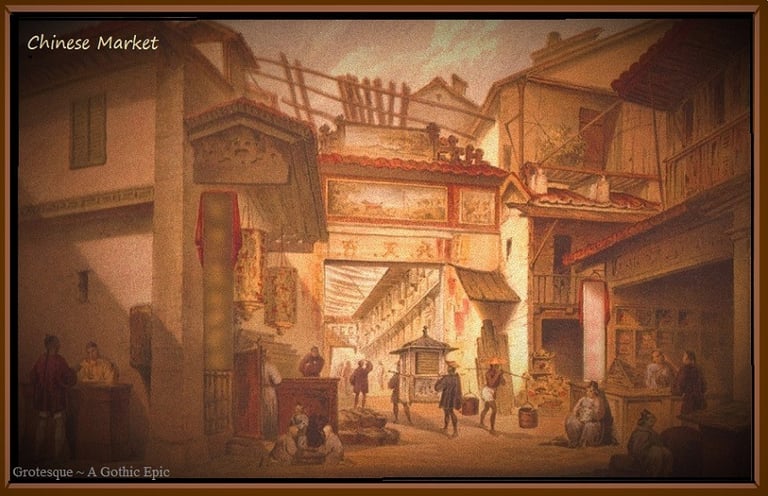
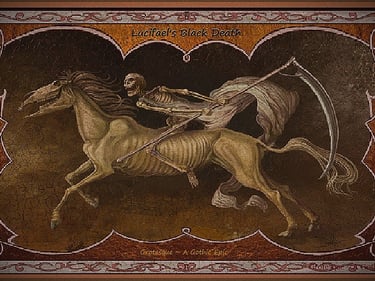
In only a few days, the ensuing outbreak of disease swept through the Chinese village like a tsunami. The children, closest to the earth and to the animals and insects that crawl across it, were the first to sicken and die. The morbidity rate of the infection was bone chilling, soaring to nearly seventy~five percent. The mild winter offered ideal conditions for the spread of the disease, and the coming warmer weather would be yet more devastating to humans, more bountiful for the bacteria. Although happiness in Hell is quite rare, in that moment of tragic human infection, Lucifael capered. Man was ripe. The warm conditions were ideal to offer Death a bountiful harvest, Death who stood ever at the ready wielding a honed and gleaming scythe like a seasoned hired hand poised eagerly to reap of the plenty.
Those infected with the plague died abruptly, as the germ was thorough in destroying their immune systems. It attacked lymph nodes unto rupture, rendering them useless. The victim’s body had little time to defend itself before it fell, completely overwhelmed. Hemorrhagic blood pooled beneath the victims’ skin in black splotches, and their infected body fluids ~ blood, sweat, and wastes ~ carried a horrifying stench.
The Bubonic Plague was one of Hell’s more clever designs. The breath of Lucifael was devious, and her desire was complete annihilation of her adversaries. Thus the plague was a chemical shapeshifter: what it did not accomplish in one form, it achieved in others. The disease changed, and a second wave of infection danced its dark way across the field of human life, and then a third wave. The pneumonic plague infected the lungs of its victims and multiplied there so rapidly that the chest cavity of the hapless victim swelled and filled with blood within days of infection. Though some survived the bubonic plague, pneumonic plague took no prisoners. Worse, the infection was easily transmitted through a cough or a sneeze ~ death filled the very air.
The third form of infection proved deadliest of all. Septicemic plague attacked the blood, filling every particle of body tissue with the wildly multiplying bacillus. Victims died within hours, their inside organs literally liquefied in pools of highly infectious blood. Like the lung~borne form of the plague, the septicemic infection was nearly one hundred percent fatal.
The pestilence spread rapidly from its source and engulfed the countryside. Three~quarters of all surrounding villages and towns now exposed to the plagues were decimated within days. In the following weeks, hundreds of thousands of infected dead lay strewn across open fields because few dared bury them for fear of infection. The fly population soared, the rotting corpses fine incubators for their larvae. In the more developed areas of the country, the stench of blackened, bloated corpses was so concentrated that a dead village could be smelt nearly ten miles downwind. A mass migration commenced as tens of thousands sought refuge in remote, unsettled areas.
Even in their panicked flight, travelers avoided established roads, which were littered with the rotting remains of people, sometimes entire villages. Rural roads were often blocked by fly~filled carts hitched to dead horses. Death and decay was everywhere. The Plague reigned, and men were its slaves. The Great Pestilence took more than thirty~five million Chinese lives in sixteen hard years, and still it was not sated. The plague marched silently into Mesopotamia and Asia Minor, laying waste to them as it had China, sweeping across entire continents like some vengeful, marauding horde.
The disease coursed through every vein of Asian civilization, following trade routes that spread through the heart of Mongolia. The Silk Road, an ancient caravan route that carried goods of the East to the Mediterranean Sea, now carried Death’s appointed handmaiden toward Europe. Indeed, Death breathed over the land like a foul breeze, tainting the air with the rancid odor of putrefaction. Its unholy stench was ripe enough to anesthetize even the heavens. Thus it happened, as horrible events in history invariably do, that Lucifael’s message rang out across the lands ~ she would soon reclaim her own.
Vol. I: Chap. I ~ finis.
Next Chapter~
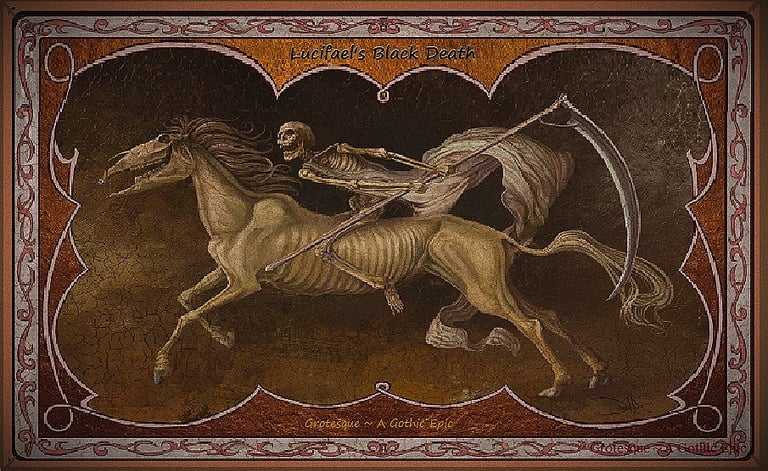
~2: Battle of Crecy

“But when they find the frowning Babe
Terror strikes thro the region wide
They cry the Babe the Babe is Born
And flee away on Every side“
~ W. Blake
Grotesque ~ A Gothic Epic © is legally and formally registered with the United States Copyright Office under title ©#TXu~1~008~517. All rights reserved 2026 by G. E. Graven. Website design and domain name owner: Susan Kelleher. Name not for resale or transfer. Strictly a humanitarian collaborative project. Although no profits are generated, current copyright prohibits duplication and redistribution. Grotesque, A Gothic Epic © is not public domain; however it is freely accessable through GothicNovel.Org (GNOrg). Access is granted only through this website for worldwide audience enjoyment. No rights available for publishing, distribution, AI representation, purchase, or transfer.