Add your promotional text...

Preface
Author Note~
A crucial point to recollect when reading Grotesque ~ A Gothic Epic, is that the reader shall experience an outwardly fantastical world through the heightened senses of Lazarus, the story's main protagonist, who is gifted with a vision to peer far beyond limitations of mortal sight, and see deeply into the spiritual realm of specters, angelic spirits, fallen souls, dark shades, impressions and constructions of distant pasts, and beings that have long passed on, yet secretly remain and inhabit our earthly domain. Lazarus is your lens to a deeper, wider, unseen world, where myth and belief intermingle with primitive reality and its historically sublime constructs. From Lazarus' uncanny perspective (perhaps representing an inexpressible point of semi-divine perception) the reader is able to see the entire epic and unfolding drama, which would not otherwise be available through the limited senses of a mere mortal human. This allows for an expansion of the 'suspension of disbelief', which may be necessary when narrations of a real world increasingly blend with the more fantastic and almost incredulous elements of the story, through its progression.
Although Grotesque begins with elements of real historical events and notable human characters, its steady migration into the mythical, fantastic, and almost absurd realms, are purposely constructed to merge the worlds of reality and mythological fantasy, and seamlessly fold them into Lazarus' epic journey. This novel construct allows for the eventual setup and completion of a fantastical, multi-dimensional trifecta of final redemption. As well, although the work may first appear tragic, filled with despair, gloom, and desolation, the overall progression and tone of Grotesque begin as low as imaginable (macabre and horrific, even) while gradually elevating beyond its epic climax, and to where the story's subsequent resolution expresses a tone that is light and pleasant, yet deep and full, and hopefully rewarding and memorable to the reader.
Grotesque is a journey through inner self, driven by outside forces; and as with the most memorable and rewarding journeys, they almost never mark their first steps with intentions of a Sunday stroll or a walk in the park. Most of us are forced into those first few steps, oftentimes reluctantly or even against our will, while driven by uncomfortable internal observations, expectations or realizations. Lazarus' journey begins no differently. He is driven to fulfill his promise to fetch a friar, who might correct a grave 'wrong' done to the world. He did not decide this journey – it was forced upon him. Refusal was not an option, since it would contradict the very foundation and cornerstone of his faith – an almost blasphemous act that would haunt him for the rest of his days. The promise that he made would become his very cross to bare in order to keep his humanity alive and prominently at his forefront, while burying the truth of his monstrous physique and infernal origins within the furthest recesses of his mind. His solemn word then given, his commitment was complete – and this changed and rearranged everything within him. As Lazarus begins to realize, he is only part of a much larger story ~ he was born into it and molded by it. He must break and remake that mold in order to understand and accept his 'natural' self, since it is paramount to his proper navigation of the outwardly existential, fantastical, and chaotic world that repeatedly unfolds before him. This acceptance of personal responsibility, need for dynamic and responsive decisions and actions, and a personal appreciation of his true 'physical and mental make' is crucial to his very existence, since it marks the very completion of his journey and the resulting belief that will forever inwardly define him.
Please note that, although Lazarus' journey reveals him as the story's main protagonist, progressing through his many trials and tribulations, there are three more parallel inter-connected and interdependent story lines within - two that are tragic, and two that are not. They weave in and out of the main story line, much like braids of hair, each impacting and reacting to related elements and unfolding events within the other story lines, where chronological order is the backbone of the braided work.
I hope you find Grotesque, A Gothic Epic, to be as rewarding a read as I have enjoyed constructing it. All the best,
~G.E. Graven
Preface ~ Fin
So It Begins~
~Prologue
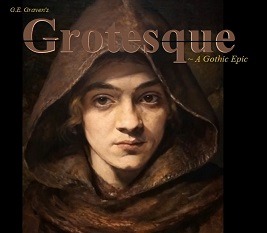
Grotesque ~ A Gothic Epic © is legally and formally registered with the United States Copyright Office under title ©#TXu~1~008~517. All rights reserved 2026 by G. E. Graven. Website design and domain name owner: Susan Kelleher. Name not for resale or transfer. Strictly a humanitarian collaborative project. Although no profits are generated, current copyright prohibits duplication and redistribution. Grotesque, A Gothic Epic © is not public domain; however it is freely accessable through GothicNovel.Org (GNOrg). Access is granted only through this website for worldwide audience enjoyment. No rights available for publishing, distribution, AI representation, purchase, or transfer.