Add your promotional text...


An Undying Love
Volume 1: Chapter 19 ~ Shell of a Man | Grotesque ~ A Gothic Epic | G.E. Graven
Download Chapter 19 as EPUB or PDF
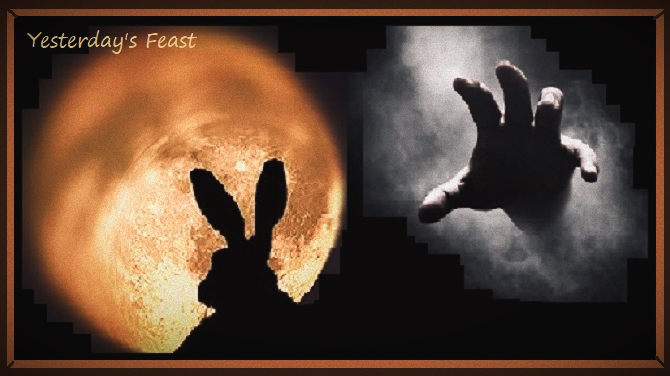
In the heart of one of France’s southernmost provinces and atop a narrow ridge, tall grasses parted to offer a hare that hopped into a moonlit clearing. The wary animal inspected an open knoll with perked ears and a twitching nose; and as it crept forward, it suddenly froze like stone, its head cocked sideways and a single, glassy black eye affixed on the heavens. The petrified animal stared at that which might have resembled a single flying spec ~ a soaring silhouette, adrift against the stars. The rabbit sat motionless beneath its perceived bird~of~prey.
Yet the high~flying object bore little resemblance to any bird, save its spread wings; and a trained eye might correctly gather its form to be that of a flying man. Abruptly, the startled hare spun and tore into the long shadows from whence it emerged. And in the apparent safety of thickets and deep shadows, a ghostly greenish hand parted the brush and snared the thrashing hare. Bones popped and a new silence settled over the grassy knoll.
Gliding high above the ridge and soaring against a star~studded sky, Lazarus pressed onward. The wind moaned with the rhythmical roll of his wings. Flying toward the southernmost coastline of France, and from Lazarus’ lofty vantage point, he saw the moonlit lands spill from out of a curved horizon like a sublime scroll that slowly unfurled every facet of Creation. To his left, a row of low hills glowed in golden hues, sharply defining the eastern edge of the earth. To his right and beneath a sulfurous crescent moon, heaving terrain blended into an indistinct western horizon that appeared to liquefy like quicksilver and meld into a hazy sky.
Lazarus had long since left the winding course of the Rhone River, and now he flew due south over a scattered landscape of naked hills and broken forests. Below him, twisting streams sliced through the entire terrain and; en masse, they could have resembled black and wandering dagger scars that marred the face of the earth. Clusters of tiny structures rolled into view ~ thatch~roofed buildings perched alongside riverbanks, altogether suggesting the presence of quaint fishing villages. Betwixt them, rural roads were as veins of dirt that dispersed and disappeared through shadowy woods and foothill valleys.
Unlike the meandering paths of the roads and streams below him, all of which appeared compromised in the face of uneven terrain, Lazarus forged a deliberate course, defying persistent crosswinds and downdrafts. He carved a path, straight and narrow, strictly south. However, he hardly acknowledged the rolling sea of earth beneath him. In the immutable groan of the wind, and beneath the steady beating of his wings, Lazarus might have been flying blindly, as most of his focus lay turned within ~ his attention attuned to a troubled mind.
Perhaps only angels might have gathered such a miracle or method for how a heart so heavy as his could possibly remain aloft, even to skirt the stars and not hurtle to earth from the gravity of its own shattered state. Lazarus’ mind reeled with remote memories of bygone days. And with his every perfect recollection of them, the memories seemed to heap themselves together like a pile of rocks that swelled into a mountain and buried every trace of what he purely remembered himself to be. Without the comforting confines of the catacombs; without his tunnel chores; without Ivan and Odino to console him; even without Clodious and Greville to scold him ~ without his worrisome facemask, Lazarus wept. No longer could he deny that disquieting part of him, which was once but a whining whisper hidden within the deepest recesses of his heart, as it had finally grown to stir strongly in his breast. ‘Twas no longer a nagging pain but perhaps a waking and screaming consciousness that commanded his attention. Indeed, the bothersome whisper swelled into yowls of torment, utterly revealing itself as confirmation that the most cherished part of Lazarus had truly perished on that awful eve, when forced to leave the abbey. And although the voice in his heart was his, alone; it was certainly fostered by the blasphemous and murderous fisherman; the greedy feuding lords, D’Alcicourt and Hugon; the cold and loathsome Captain Bourne; and most of all, his thoroughly ungodly mother, who was all of them and more. And to Lazarus, the bitter memories of them seemed to devour his every perfect and heart~warming recollection ~ his every joyous and naive dream of a prior and perfect world that he had experienced before his expulsion from the comforting womb of his former catacomb quarters.
Yet, even as sorrow might sometimes surrender the spirit, invariably, reason often regains what was lost within. Lazarus closed a troubled heart and opened his mind to more meaningful considerations and calculations: he was flying~ over Southern France~ on his way to Italy. And what he once naively thought to be, a most unattainable goal: to fly somewhere and fetch a friar; was really quite a reasonable feat, as he was now doing just that. He considered what might immediately transpire after he returned to the abbey with Friar Salvatino. Alas, since the Captain had exposed his true self as, but a grotesque concealed in squires’ robes, he was well aware that his life would follow a different course than he had previously imagined. From that single turn of events, he gathered with good reason that the abbey monks could not accept him into their holy fold as a friar. He was convinced that they would no longer allow him to live and serve in their flock as a man of the cloth. He was certain that they would never again revere him as Lazarus, the abbey’s trusted catacomb squire, but revile him as an ugly and ungodly winged beast. Unequivocally, he knew that he would not find his place in prayer, in the Sanctuary, but atop it, in stone. Still, he recalculated his options only to arrive at the same unwavering result: to remain steadfast in his promise to fetch the friar. ‘And if by likelihood, some remainder of goodness might be derived from it,’ he thought, ‘perchance, the abbey monks might look beyond his differences and determine him to be more Man than beast.’
Nevertheless, for Lazarus, it seemed unlikely that any degree of consideration would change the moment for the better. Time turned over the rolling earth and, with the weight of an open gatestone resting squarely on his shoulders, Lazarus continued forward over Southern France. The sweat of his wings glistened in the moonlight and; as the night wore on, he held true to his course and speed even as he drifted closer to the earth. Like a massive bat, he blazed over treetops, churning its canopy leaves with wafting wings. He flew onward, pacing his wings to his breaths ~ press and lift, in and out. Time turned again, when a flock of sea gulls gathered alongside him. More resting gulls erupted skyward to give chase. The birds gathered into a growing swarm and; at length, hundreds of them formed an immense flock that all but engulfed Lazarus. He climbed higher to escape them yet the followed. He dived; banked left; rolled right. Yet, they reacted precisely with the same aerial maneuvers. He leveled himself and searched for the horizon to find only a wall of churning tail feathers. And beneath him, the face of the earth drowned in a heaving sea of white wings.
Lazarus swiped at them, shouting, “Be off, now!” They shrilled at him, as though his brash command called for mass protestation.
“Move aside!” he cried. They cawed and further converged, outwardly smothering him like a hundred chicks clinging to a mother gull.
“I cannot see!”
The flock only replied with chatter.
“I am not a bird!”
The gulls complained as one.
“I’m not!”
They resounded with a barrage of sharp retorts.
Lazarus huffed and surrendered himself to them, considering that although he was flying blindly amongst them, he still made headway. What was more, it did appear to him that the flock showed a keen sense of space, since none of them seemed to impede the wing beats of the other, or his own, for that matter. Yet there was even more to them, as Lazarus found himself drawn to their gawking, dark eyes. On the surface, they seemed to share the same wild intensity. He stared deeply into them ~ even deeper than he once looked into the eyes of Mountain Mouth’s dogs, and he found~ absolutely nothing. And perhaps it was, the nothingness in them, that spurred Lazarus to chuckle. The gulls crooned.
Lazarus chortled and they cackled with him. And the louder he laughed, the more noisily they replied until; at length, Lazarus found himself drawn into cramps and tears. Truly, he knew the seed of his hilarity and openly amused himself with it. The gulls’ blatant stares were as wide and blank as those of Mountain Mouth’s bats ~ they were the identical gape as that of the rat, which Friar Clodious chased through the abbey catacombs ~ and perhaps, they mirrored the same gawp as that of the friar, himself, when Lazarus emptied the wash pail over his sandals. Altogether, both recollected and real, their stares seemed to convey to Lazarus, the simultaneous yet discordant states of determinism and obliviousness. Had he not initially found the seed of humor in their wide, cold stares; he might have found himself, frightened to fly amongst such a flock of hollow, burning eyes. Nevertheless, as he pressed onward, he opened an intimate dialogue with his tag~along drove, telling it of secrets that seagulls could not possibly repeat or understand. He shared with the birds, truths that he had only admitted to the bats of Mountain Mouth. Indeed, they were quite curious and receptive of Lazarus ~ all of them intently interested with his ongoing oration. And occasionally, they erupted with a communal squawk, caw, or coo, as to convey a common opinion or contradiction.
At length, however, the gulls seemed to grow weary of his company and veer off. The flock thinned and the light of the night sky illuminated churning wings. Still more of them fell away, disbursing in droves to expose the rolling earth beneath Lazarus’ feet. The remaining flock abruptly exploded, leaving Lazarus to fly alone. And with the wall of gulls before him now gone, his eyes found an unexpected and vastly different southerly horizon than he last recalled; as he saw its new shape to be nothing short of a panoramic horrorscape. He leaned backward, thrashed his wings, and quickly stilled himself to hover in place. He treaded the air, feeling unnaturally heavy. ‘Twas like his life’s blood drained from his veins ~ as though his very bones gained a gravity of stone. And in that disquieting moment, whilst Lazarus believed to experience the full pull of the ground, he absorbed the enormity of the outwardly inexplicable spectacle before him; as the entire face of the earth appeared to surrender itself to a vast sheet of black glass that all but washed the world into oblivion. 'Twas an awesome spectacle of apparent and endless emptiness that only Noah could have known.
From his overlaid recollections of the abbey maps and the measured distance that he flew, Lazarus knew that he had since arrived at the Gulf Of Leon; however, he never envisioned its body to be so massive and sprawling like the lion~of~an~ocean that it now seemed. New concerns brewed. He tucked his shoulders and dived into a spiral, following his feathered friends back to a line of coastal rocks that divided land and sea. He lit amongst the grounded birds, perching himself atop a wide and weathered slab. The gulls complained and beat their wings. They pecked at his boots, perhaps believing that he had come to steal the beached carcass of a hollow~eyed fish, which they guarded. Lazarus squatted and draped tired arms over knees. Beads of sweat coursed over him, angling backward with the inland wind. His wings loosely splayed behind him, he breathed heavily to resemble an overheated bird. There, on a squat plateau of stone, he collected himself. He watched the heaving tides surge betwixt the rocks as they sprayed him with a brackish mist. He studied the water’s edge, where a blanket of ocean foam rose and fell over every new wave. Nearby, part of a crab shell rode a bit of trapped driftwood that bobbled betwixt a narrow space of boulders. Against the boulders, dense threads of algae rolled as one in the waters’ currents. Beside Lazarus, the gulls had finally turned an attention to themselves, sparring over the fish carcass. And as the cool breeze of the gulf blew dry his damp wings, Lazarus closed his eyes and burned into everlasting recollection, the newly experienced sounds and smells of an ocean.
Within him, the once brewing concern grew into a nagging voice of protest that churned in tune with the black waters at his boots. He rechecked his memory of the abbey maps and recalled that, in his planned journey to fetch the friar, he was to embark on an evening crossing of the Gulf Of Leon and arrive at the Isle of Corsica, where he would again seek shelter from the light of day. And initially, the feat seemed quite attainable, since he knew that he could fly the distance. Nevertheless, the sight of the sea from a height so great as that of a bird’s eye, where he witnessed its appearance to be so magnificent and outwardly monstrous as to swallow every earthly detail for what seemed to be, an easy stretch into infinity, made the feat seem more unthinkable than attainable. Indeed, the nagging voice complained for good reason, as it now revealed to Lazarus the disturbing notion that his crossing an ocean was not merely a feat of flight, upon which he so heavily relied to survive. After all, the voice knew that Lazarus could fly for a full eve; however, he could not swim, for even a moment.
Lazarus rocked himself forward, knelt, and sank back on his heels. He peered past the waves and inspected a dark ocean horizon that seemed to fuse with a dim sky. The sprawling black seascape had every appearance of a bottomless and boundless abyss, and he mused that even the clouds might be incapable of crossing such a vast void. He turned his attention to the southwesterly heavens where heat lightening flickered in the distance. Then he sighed and stood as he bid the gulls a somber farewell. He unfurled his wings, took to the skies, circled once, and headed east, turning his back to a setting moon.
For the remainder of the eve and well into the early morn, Lazarus followed the southern coastline of France. With the abbey maps etched firmly in his mind, they served to guide him toward the eastern port city of Marseilles. He kept the sea to his right and the land to his left, even as a steady southerly crosswind seemed determine to shove him out to a foreboding ocean. And to Lazarus, the ocean seemed evermore like a hellish chasm ~ a great black hole that was hungry ~ that mocked him, daring him to cross it. At length, the crosswinds weakened and died before a brackish breeze blew inland to counter it. However, the warring winds had already taken a toll on his wings, and Lazarus turned his attention to the ground, where he might find suitable shelter from the first rays of day.
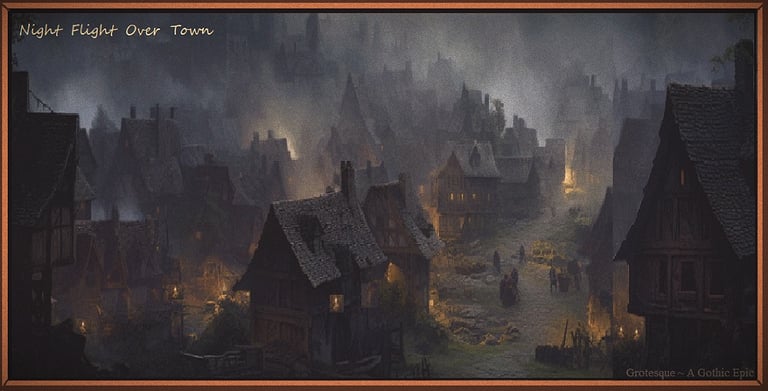
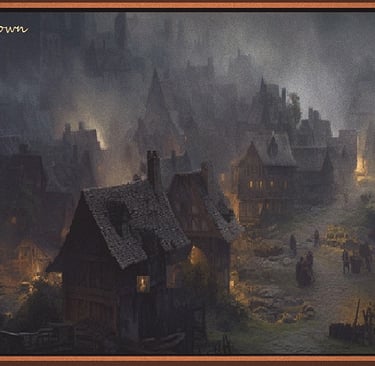
Still far from Marseilles, Lazarus descended upon a quaint port village and circled gradually wider over thatched rooftops until he found, on the more remote eastern edge of the town, the apparent ruins of a former cathedral, perched atop a broad and rocky hill. Upon closer inspection, he saw all that remained of the high~pitched and roofless structure, with scorched and partially fallen walls that enclosed an exposed flagstone floor. Yet he found that there was more to the outwardly dead place of worship. Encased within its crumbling fortifications, a quaint structure much like a newly built church, stood atop a portion of its floor stones. The newer church was completely wooden, save one outer wall of stone that it shared with the ancient cathedral. Altogether, the apparent wooden spec could have bore symbolic semblance to a spring~ready seed caught in the womb of a winter~smitten bloom. And aside from a bone~carrying dog that limped through a sprawling cemetery that claimed the eastern side of the broad hill, Lazarus found the immediate grounds of the ruins to be all but dead.
He set down within the broken walls of the ruins, planting his boots softly atop weed~lined flagstones. Lazarus winced, carefully folding his worn wings before slipping into the darker shadows. He barely approached the rudimentary church when he saw its tall and narrow windows and realized that the building was grossly inadequate for the shelter he sought. Lazarus turned away and stepped through a gap in the olden wall. Then, outside the ruins, he followed the wall’s length, walking through fallen wall stones and tall weeds, until he rounded its exterior corner and found, nestled within the weeds and overgrown with vines, a large but narrow storage bin. The higher backside of lean~to box stood flush against the ancient temple wall. Its lower front~side faced the receding hill of congested and decrepit gravestones. Lazarus cleared away the weeds, lifted the bin’s weathered lid, and peered within. Aside from a few broken tool handles, several dry~rotted hemp sacks, and scattered clumps of dried mud, the interior appeared spacious enough for his planned short stay. He slid himself within the box, closed its lid, reshuffled its belongings, and closed his eyes to the coming dawn of a new day. And Time returned to his world of dreams.
Indeed, the bin was of sound construction, with solid walls and a flush lid to guard Lazarus from glaring daylight. However, as good fortune might oft times require a price paid for services rendered, the very box that kept Lazarus alive, might have easily served as his coffin. Had the following day’s sky been free of clouds, he would have certainly perished. The morning sun baked the box, awakening Lazarus to consider his immediate fate. He thrashed about in the sweltering bin, struggling to breathe the stale and heated air within. And in his inescapable predicament, he had ample time to reflect upon a most grave mistake: He laid himself to rest within a wooden box that directly faced East. Still, the sun ascended into the heavens like a riling god of fire, searching beneath itself for all that it might consume and whither away.
By midday, Lazarus suffered agonies best found betwixt vacillating throes of thorough nausea and appalling self~awareness. Repeatedly, the recollected cries of the fisherman rang in his ears, saying, “LAZARUS, OPEN THE DOOR! FOR THE SAKE OF GOD!” He drifted in and out of consciousness, his mind divided, his body stricken. Like a swinging pendulum of torture, the horrendous event persisted ~ in and out, in and out. Like clockwork, with his every mental spiral into oblivion, his body re~woke him to even greater pains. And in those most tortuous moments of consciousness, when the pain might have swelled even to mock the frailty of his own mortality, Lazarus could only clutch his father’s prayer cross with tremulous hands and plea for another unconscious spell. Yet, no mercy fell over him ~ nothing fell, save the continued burn of an unforgiving sun.
Lazarus felt himself near to death before the sun commenced its westerly descent. Long shadows of the cathedral ruins finally crept over the bin. The blistering air of the box eased as dusk painted the clouds with reddish hues; and Lazarus emerged from his dizzying dreams only when the deepest twilight settled across the sky. The cool glow of a million stars and a sliver of moon soothed the land. Lazarus lay panting atop drenched burlap sacks. His head reeled with a ringing noise, which now seemed interwoven with indistinct voices. At length, the ringing in his ears subsided even as the voices persisted and, when Delirium and Reality had finally separated themselves in his mind, he discerned the voices as belonging to that of an outwardly heated conversation. He rolled to his side, raised his hand, slid his fingers betwixt the bin lid and frame; and with the lid ajar, a wave of cool air spilled over him. He lay still with a perked ear to hear more of the ongoing exchange. The voices seemed to reach him from afar, perhaps originating from down the broad hill and deep within the cemetery. And there was something queer about the discourse ~ however unclear or disconnected ~ which worried him deeply.
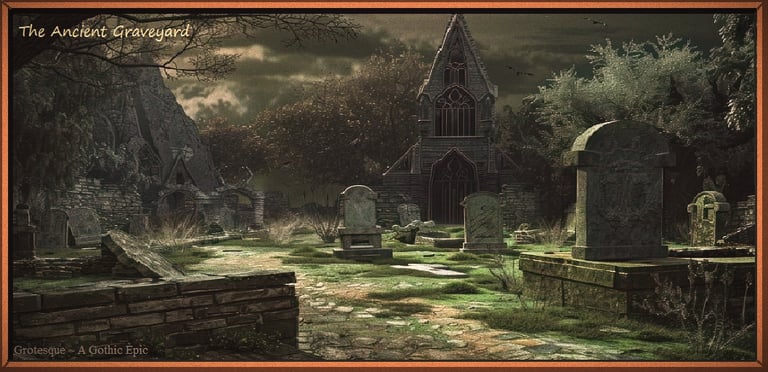
He listened intently whilst a manly voice pled aloud; “Hear me! A moment more, I beg of you!” A lingering pause followed.
“A moment more, you shall have. Make haste, your parting.” The unnatural reply, akin to the voice of Lucifael, speaking in the synchronized voices of many women at once. Yet this otherworldly voice seemed distinctly different ~ outwardly more gentle and refined, yet stern and proper ~ as it trailed off in reverse echo~like calls.
Lazarus tensed; his breath quickened. Had the haunting reply not been so tonally deep and braided with masculine voices, the utterance could have come from Lucifael, herself. But the words were not hers; only like hers. Lazarus lifted the lid even higher and peered into the moonlit graveyard.
“Alone, if I may?” The pleading voice implored.
To which the angelic voice answered, “Do not tarry overlong.”
Flickers of light illuminated rustling leaves and weeds. In a dying gust of wind, a new darkness and silence settled over the cemetery.
Lazarus’ pupils swelled. He searched the grounds before slipping out of the storage bin. He looked to the heavens, which called for flight; however, he stood grounded by the overwhelming inquisitiveness that plagued him: that unnatural but unfamiliar voice, which was akin to the tune, but unlike the tone of his mother. In that same moment, Lazarus also recalled his father’s words, warning him to stay away from the dangerous Benion Tunnel; yet still, he also acknowledged that, had he not ventured down that forbidden tunnel, he would not have learned of the angelic writing or the Naramsin Scrolls. And thus, he would not have gained that precious knowledge of himself, his origins, or his Eljo familiars. Indeed, he could not easily turn away from the cemetery and its unfamiliar voice~of~many, when even more of the same uncommon knowledge might lay only footsteps away.
Under cloak of darkness, he stole his way down the hillside, reserving his presence to only the darkest shadows. No brittle twigs or loose rocks, did he trample, as he passed silently through unkempt graves. He weaved an irregular but stealthy path toward the heart of the burial grounds, and to a shady grove of ancient oaks where he saw an ethereal, greenish glow that showed itself brightly amongst the underbrush. As he neared the trees from behind a shallow rise, he distinctly heard the unbroken murmur of the same manly voice that once pleaded to the other voice~of~many~men. Like a ghost, Lazarus ascended the backside of the embankment, ears erect and tuned into the solemn voice that whispered; “Should the whole of the earth pass away, I shall remain with you, my love. Alas, the good angel now knows when and where to find me; and I can no longer show myself, routinely as before. He has grown wise to our anniversaries. Even so, I give you my word, entirely and eternally, that I shall persist and prevail. As my heart is faithful, I shall revisit you all the more, yet with fresh discretion and, routine unbeknownst. You are my godsend, my love, and the only heaven I care to know.”
Lazarus parted the weeds and crouched as he neared a crumbled burial marker. He peered past the stones and a greenish glow bathed his face, narrowing his pupils to pinholes as he stared at an outwardly unusual spectacle. Before him, a ghostly image of a man knelt at the foot of a pair of marked graves with its back to him. The two graves lay enclosed within a larger stone-line plot of overgrown weeds. Rising out of the weeds and centering the two headstones, a much higher but more narrow ornately carved stone pillar bore the engravings of perhaps a family crest, with the vertically~engraved name prominently and squarely beneath it: ~M E D I C C I~. Lazarus leaned into the gravestone shadows as the specter rose to its feet, turned, and scanned the grounds. Then Lazarus saw all of it.
The visage was that of a young and handsome man, perhaps middle-aged, with shoulder-length hair. A closely-trimmed angular shade~of~a~beard traced a square jawline. The specter donned clothes of distinction, with a full cape draped over novel attire. The end~seam of its shoulder~robe gathered loosely like a curtain against the tops of its high~laced boots. Through Lazarus' divinely-enhanced perception, whilst he peered into the black of night, and evermore deeply beyond its boundaries, and deeper still, through the ever~churning ebon mists of the ethereal and mystical realm of haunts and sprites, wandering spirits and wayward souls, every facet of the ghost’s visage appeared as gleaming and translucent as the rest of its greenish and glowing form.
Lazarus stepped into the clearing and called to the apparition, “Greetings, sir.”
The spirit partly turned about and briefly froze, with a down~turned gaze, as if contemplating an unexpected introduction. Then it turned and faced Lazarus. The translucent man touched his breast, asking, “Do you address me?”
“I do,” Lazarus replied with an inviting smile and a curt bow.
“You can see me? And hear me?” the specter inquired, incredulously.
Lazarus nodded. “I can.” He paced forth and stopped.
“I’ve never seen such as you. What manner of devil are you?”
Lazarus’ smile faltered. “I am not a devil ~ I’m a flying man. I am Lazarus Gogu.”
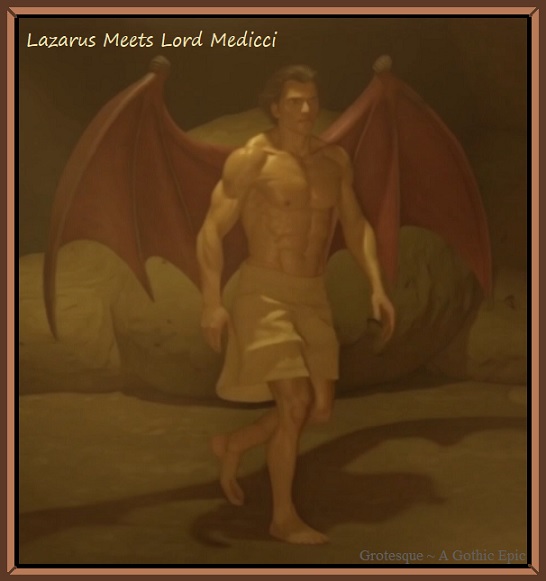
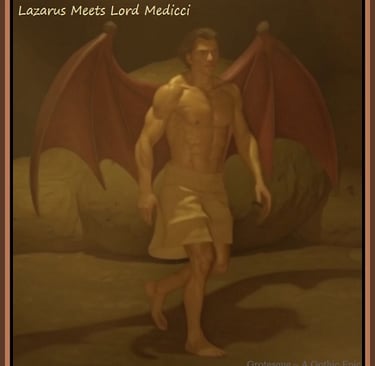
The ghost stroked its chin and studied Lazarus. “You claim as much.” Then it shook its head in apparent disbelief, adding, “However, I sense nothing about you ~ nothing at all.”
Lazarus completely lost his smile. He drew a quick breath and rebuked the ghost. “And since I can see the gravestone behind you, clearly through your self; there appears to be little of you as well.”
The visage of the man pursed its lips and admitted the claim with only a solemn nod.
“You are a spirit; a soul of sorts?” Lazarus asked, attempting to derail the discord.
The apparition presented itself with open arms, stating matter~of~factly, “As you’ve since gathered, I am.” Just as quickly, the ghost dropped its arms and coldly informed him; “And if you are in league with Hell, perhaps you might inform your principle elders and minions in chief that this soul is already claimed, and presently in the waiting company of Heaven’s escort.”
Lazarus staunchly defended himself. “I am neither in league with Hell, nor do I endeavor to conspire against the Lord God, Almighty.”
The ghost scrutinized him with a narrow gaze before asking, “Then perhaps you are in league with Heaven?” The spirit nodded in self~agreement. “If so, then you should already know that I asked for a moment alone, for to pay my last respects. Yet, here you are. Why must you espy me in secret, lest you believe me to flee?” The apparition cocked its head as a sudden expression of perplexity fell over its face. “And what sort of godly servant are you ~ the likes, of which I have never before known ~ who presents itself in the form of a demon and addresses a wayward spirit with kindly respect, yet is neither devil, nor angel?”
“I’m merely Lazarus, and I do not espy you,” the Eljo stated. “Forgive my intrusion, if you may. I was only resting, just there,” Lazarus offered, pointing up the hill and toward the cathedral ruins as he continued his confession, “when I gathered the voice of ~ the voice of many men, speaking as one. Then I saw a glow amongst the gravestones and followed your voice. I meant no ill will by it.”
A new expression of doubt laced the ghost’s face. “Resting, were you? In a burial ground? Amongst the dead?” The specter crossed its arms, nodded, and inquired further. “And why did you come to rest in this particular cemetery?”
“I merely found it in passing. I was weary. I travel to Italy.”
Outwardly unconvinced, the apparition responded, “And I am called upon to travel to Heaven. I would not be so terribly surprised that my untrusting escort is watching over me ~ and you ~ this very moment, in the event that I attempt to flee or become Hell’s captive. What say you to that?” The ghost turned its back to him and faced the grave, all the while peering over its shoulder as though, expecting a reply.
But Lazarus turned away and made to leave, departing with last words; “I would bid you Godspeed; however, in light of such a divine blessing bestowed upon you, with your call to Heaven, I cannot offer you a greater blessing. I am pleased to have known you, if only briefly. Forgive me and good eve, sir.”
Lazarus stepped into the darkness and strode toward the embankment when the ghost bellowed, “A blessing bestowed?”
He stopped, turned, and questioned the spirit; “Are you not pleased to be on your way?”
“Indeed not!” the ghost exclaimed. It huffed and grumbled, “‘Tis a dreadful thing.”
Lazarus retreated from the weeds and sidestepped a grave. He returned, now confounded, and questioned the specter. “How can Heaven be a dreadful thing?”
The ghost glanced at the grave before approaching Lazarus with a face apparently wracked with emotion. It halted before Lazarus and searched his eyes. “Because I was afforded Heaven and my dear Sophia was not.” The ghost shook its head. “For over two hundred years I have battled the wills and skills of angels to remain ~ to roam the world as a lost soul, so that the last memories of my wife stay alive ~ in me. I do not intend to go with this angel. I've only come to pay respects to my dear Sophia once more – 'tis the day of her birth. The angel knows to find me here every year, and awaits my religious return. And every year, we relive the same encounter: I come, She catches me, I pay respects whilst the angel waits, and then I flee once more. I believe it may be more out of pity than stupidity that she has never given pursuit; although she may, one day~ or even now. I should again slip away, promptly.” The hollow man looked away and stared through the trees, toward the cathedral ruins where he knew the angel~in~waiting to be.
Lazarus followed the ghost’s gaze. Then he offered, “I am sorry to hear of it.” They stood in silence and peered at the temple remains.
The ghost looked back at him and sighed. “‘Tis I, who must beg your pardon. I wrongly suspected you for being a bearer of ill will; and I’ve no place to burden you with my woes.” The spirit drew a quick breath, nodded, and put on a polite smile. He presented an inviting hand toward the gravestone, saying, “May I present my lady, Sophia, and me ~ we rest here.”
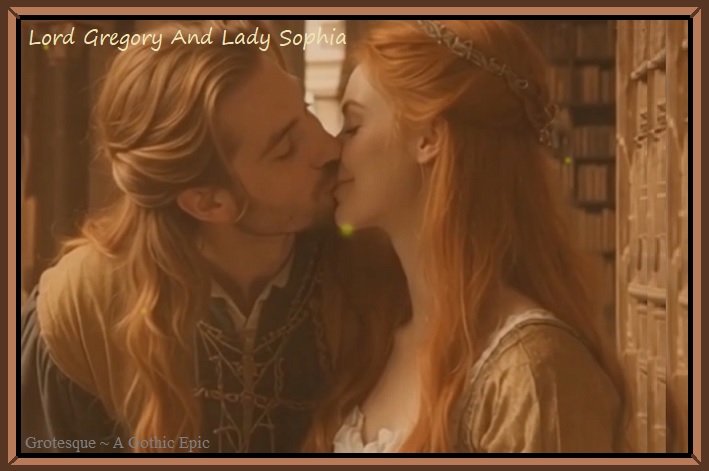
The ghost looked squarely at Lazarus before snapping a bow of curt introduction. “I am the late Lord Gregorie Medicci, formerly of Florence. ‘Tis a pleasure to meet you, Lazarus Gogu.”
Lazarus smiled and returned the bow. “Your Grace, the honor is certainly mine.”
“So what takes you to Italy, young sir?” The ghost of Medicci fluffed his cape and leaned around to inspect Lazarus’ tucked wings.
Lazarus guardedly answered, “I must find a man and accompany him back to France.”
“If I may inquire, for what purpose?”
Lazarus looked away. “I mustn’t speak of it; forgive me.”
Medicci folded his arms. His elbows widened the cape that draped over him. He leaned forward, smirked, and quietly asked, “Is any secret so grave that it dare not be whispered even to the dead?”
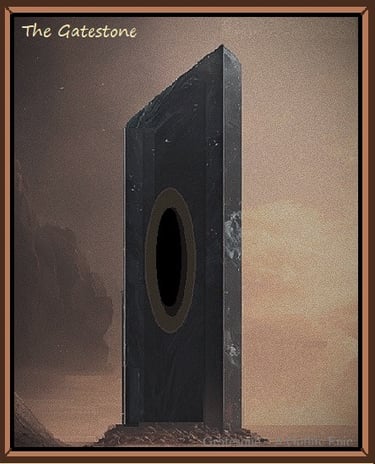
Lazarus searched him, shrugged, and shook his head. “Perhaps not.” He divulged his mission. “A gatestone has been opened. I seek a friar in Italy who can close it.”
Medicci retracted his chin, apparently perplexed as he inquired, “Gatestone?”
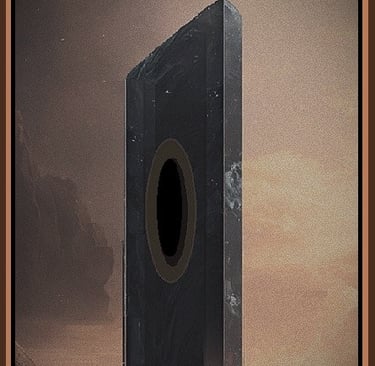
Lazarus fumbled with a suitable explanation. “‘Tis a seal of sorts ~ a gateway to ~ well, to Hell.”
Medicci widened his eyes. He quickly scanned the burial grounds, perhaps looking for the good angel~in~waiting before leaning closer to Lazarus and whispering fiercely, “Say again ~ a gate?”
Lazarus nodded. His eyes also skirted the grounds, as if searching to discover any sign of his mother. Then he began to elaborate in a whisper, “‘Tis a doorway to Hell that now stands ajar. I swore with promise to find the friar and right this wrong. My word is a sacred pledge and I shall faithfully fulfill this final request, so long as I am able; as my very faith commands no less of me than to see its completion ~ a holy promise made and kept.”
Medicci leapt forth and grabbed Lazarus’ shoulders. “What manner of gate? Tell of it!” Lazarus leaned away, yet the ghost’s icy grip remained firmly upon him. “Can spirits traverse it?”
Lazarus eyed the ghost’s balled fist on his shirt. Beneath it, a deadening chill crept through his arm, as though his flesh and blood cooled quickly to the bone. He admitted, “Spirits have escaped from it. I suppose that they might also pass through it.”
An sudden air of desperation clouded Medicci’s demeanor. He stole another glimpse over his shoulder and tightened his grip. “You must take me to this gatestone!”
“I must find the friar, who is elsewhere,” Lazarus firmly replied, staring at the ghost’s rather abrasive embrace.” “I am not en route to the gatestone of which I speak.”
“Then, so you must ~ firstly, you find your friar in Italy! After which, you shall escort me to the gatestone, yes?”
Lazarus clenched his jaw. He peered at the ruins that overlooked the broad hill. “And what of the waiting angel?”
The ghost shook him. “She can wait a bit more, as she faithfully does! There is no time, here! We must flee at once!”
Lazarus hardened his brow and yanked himself free of the specter’s utterly cold grip.
Medicci quickly surrendered his hands. “Forgive me, Lazarus; my passion overtakes me.” He stepped back, bowed, and kindly asked, “Might I accompany you on your quest? I shall want for nothing more, and burden you with even less.”
Lazarus rubbed his arm, warming it. He nodded. “If you wish.”
Medicci curtly smiled and implored him, “Then I beg of you, that we take our leave ~ in haste.”
Lazarus sighed, admitting, “Your Grace, I am not certain that I can even make the journey to Italy and back again.” He gestured toward the temple ruins. “However, an angel awaits you ~ your Heaven is here, even as we speak.”
Medicci shook his head. “‘Tis furthest from the truth ~ heaven lies behind a gatestone.” The specter thrust an open hand to the night sky. “Now, shall we be on our way? Yes?”
Together, Lazarus and Medicci abandoned the oak grove and tore into the heavens, leaving in their wake, a pair of ancient graves and an unsuspecting angel.
~*~
For the remainder of the eve, Lazarus and Medicci stayed a determined course over Southeastern France, flying over the rolling hills of Massif des Maures. They made steady headway toward the twin coastal towns of Saint Raphael and Saint Tropez that Lazarus recalled from the abbey maps. While they exchanged few words, they never failed to cast wary eyes over their shoulders for signs of a pursuing angel or flying swine devil. Unalike as they were, in shape and form, their guarded behavior might have suggested a common thread betwixt them ~ they shared the same primal concerns as hunted prey.
‘Twas early morn when Lazarus finally reached the ocean. With ample time to spare, he turned south and followed the coastline, in search of the village of Saint Maxime, where he might regain his bearings with respect to the many maps in his mind. He combed the coastline until he could search no more; and he knew that he would not find the village before sunrise.
He dived and collapsed onto a stretch of beach that circled a secluded inland cove. He lay faced down in the sand and panted, wings splayed like a wounded bird. Medicci lit down beside him. “What is the matter? You are weary?”
“I cannot go on; I must eat.” Lazarus groaned, laying still.
“Ah, that one!” Medicci exclaimed with a seemed expression of successful recollection as he shook a raised and pointing finger. He clasped his hands together and paced around Lazarus, leaving no footprint in the sand. “Two hundred years, since deceased, I had all but forgotten the pangs of hunger.” He knelt beside Lazarus. “Indeed, you must eat.”
Lazarus rolled himself into a seated position, wings lazily splayed. He brushed the sand from his face and looked up to find Medicci inspecting a stony ridge on the perimeter of the beach cove. The translucent man searched the top of the ridge, seeming to stare past the thickets. Lazarus watched his wide and fixed gaze, which appeared to probe the furthest distances and perhaps peer straight into eternity. Without batting an eye, the ghost murmured, “Wait here, young sir, and I shall remedy your hunger.” And before Lazarus could part his lips to speak, the ethereal form of Medicci’s visage had vanished.
Medicci left Lazarus far behind him; and he blazed away from the cove with such swiftness, as to make even Time itself, appear to disappear. Instantly, he lit upon a grassy ridge, where he carefully parted weeds and set a hunter’s gaze upon a rabbit that sat motionless in a clearing. The hare intently eyed the heavens as if, frozen beneath a perceived bird~of~prey. Suddenly startled, it dashed toward the apparent safety of the thickets when Medicci snared the hare and snapped its neck. In a flash of green, the ghost scoured the ridge, gathered a bundle of brambles, and returned from whence it came.
Lazarus stood on the sand of the sea and stared at the spot where he last saw Medicci. Yet, only the ocean waves showed themselves. He turned about and scanned the ridge of the cove before calling aloud through a cupped hand, “Your Grace?” He perked his ears and listened for sounds in the distant thickets, hearing only the noises of perhaps clicking beetles and restless roosting birds. “Lord Medicci?” An unnatural and ephemeral crackling sound drew his attention behind him. He turned, gasped, leapt backward, and fell onto the sand. Before him, Medicci stood with an armful of kindling, a limp rabbit, and a broad smile.
Medicci approached Lazarus and matter~of~factly addressed him, “If my recollection still serves me, this one should be quite adequate for a hungry and hefty man as you.” He lifted the hare and shook it loosely as if to determine the true weight of it, adding, “A fine meal, yes?”
Lazarus collected his wits and stood. “You were there ~ and then, not ~ and then, again appeared.” He brushed the sand from himself while asking, “How did you undo and remake yourself as you did?”
Medicci lowered the rabbit and chuckled, answering prophetically, “The Dead are not as incapable as the Living might suspect.” The ghost tossed the kindling and rabbit onto the beach and kindly motioned for Lazarus to step back. Lazarus obeyed and looked on as the apparition appeared to cast itself into a blur of unnaturally rapid motion ~ and in just a blink of the Eljo’s eye, the ghost had successfully spun the kindling into a crackling fire, skinned the rabbit, cleaned it, and presented Lazarus with a skewered hare. “Well go on, then,” he insisted, shaking the bowed limb of spitted meat. “You don’t expect me to roast it for you as well, do you?”
Lazarus advanced, keeping a steady eye on Medicci as he took the skewer from him. Medicci nonchalantly smiled and sat down on the beach. He looked up at Lazarus, who stood still, and gestured toward the fire, wittily whispering, “You must hold it over the fire now, Lazarus. The fire prepares it.”
Lazarus caught himself staring at Medicci. He grumbled and took his seat beside the fire, saying in defense of his abilities, “I am aware of how to prepare it.” He swung the rabbit over the fire and looked at Medicci to find him smirking. Then he inquired of the ghost, “How do you move so quickly? How can you make such things happen?”
Medicci raised his brow as a dare~devilish expression came over him. He looked intently at Lazarus before suggesting, “Perhaps Death is but a different shade of Life ~ with timelessness being one of its many features.” Medicci allowed him a moment to consider his words before softening the mood with a welcoming grin.
Lazarus drew a breath and dropped his gaze to the roasting rabbit. “If you would, tell me the magic of it. How did you make the hare?”
The ghost leaned forward and pretended to look about for prying eyes before pointing beneath his cape and whispering to Lazarus, “I did not actually make it. The magic of it is ~ that I hide hares beneath my cape.”
Lazarus inspected all of the ghost. “But I can see clearly through your cape; and there were no hares.”
Medicci snorted, laughing and admitting, “I do jest ~ there were none.” He half~collected himself and explained the truth to Lazarus. “‘Twas no magic in it.” He shrugged, presented opened hands, and casually remarked, “I merely presented you with a hare that was not readily apparent to you.” He shook his head. “‘Twas certainly no act of sorcery; I didn’t actually make it.”
Lazarus narrowed his eyes and rebuked him; “But I saw you holding nothing; and then you held a hare. Did you not succumb to some means of bedevilment or witchery in order to summon or conjure the hare from out of nothing?”
“No, young sir,” Medicci replied, leaning back on one arm and resting the other atop a newly propped knee. “Let me share with you, what I’ve gathered of magic and miracles.” He paused briefly and stared at the sand as though to reflect upon past memories. He drew a breath and continued, his voice imparting a more grave tone, “In my earthly days, I have witnessed many accusations of magic and sorcery, and even more claims of blessings and miracles. And as a former practitioner in the arts of alchemy and mortal physiognomy, I have had both the obligation and the opportunity to dispel such accusations and claims through discovery, keen observation, and recorded truth. My life was my work ~ I lived by it. With that said, I held true to my faith and convictions, and always knew that there existed, a reasonable explanation for an otherwise inexplicable event. In my years as a physician, I cared for many patients ~ some of whom suffered minor ailments and unexpectedly died, and others, who were mortally ill and still survived. And to all of my patients, I extended the same meticulous and indiscriminate care, no matter their condition.” Medicci looked squarely at Lazarus and smiled before asking, “Now why might you suppose that the survivors of those patients who had unexpectedly died, accused me of gross neglect or murder, whilst others who learned that my patient had unexpectedly lived, either accused me of sorcery, or altogether dismissed my care and claimed the cure to be by way of divine intervention?”
Lazarus shrugged. “I was not with you when you cared for these people. Perhaps the others, of which you speak, were not with you as well. Or perhaps they did not fully know what to expect from you.” He nodded and narrowed his eyes. “Yet, I did see you make the hare appear from out of nothing, and I do not believe it to have happened by either common or divine intervention. I know that, one does not readily pull a hare from out of the air; and God Almighty does not intervene merely for feats of trickery. I gather that only sorcery remains, which you claimed not to have used. Lest you lie, could there be another cause?”
“Indeed, there is,” Medicci replied, smiling. “And you have answered my question ~ those whom I mentioned did not fully know what to expect.” Medicci shrugged. “In truth, we are never truly prepared to experience the extraordinary; we can only brace ourselves to expect the unexpected. And if, by chance it should occur, then we might easily explain it away in order to make it seem more ordinary ~ especially through claims of divinity or witchery; magic, or even sorcery.” He briefly searched Lazarus’ expressionless face. “Nevertheless, all of these claims seem to serve the same means: to dismiss a more complex explanation of exceptional combinations of, otherwise extraordinarily common, yet rarely interconnected events.”
Lazarus stolidly remarked, “I do not understand, Your Grace.” He rocked forward and rolled the rabbit over the fire. “However, without my sounding overly simple or disconnected, might I inquire as to how you made the hair appear?”
Medicci stated, “To you, it might have merely appeared; yet, in truth, I fetched it from afar.”
“Fetched it? From afar?” Lazarus cast an eye of doubt. “Yet, you vanished and showed yourself without delay. You had no ample moment to fetch anything.”
“Or did I?” Medicci chuckled. “What are moments to the dead; young sir?”
Lazarus asked flatly, “If I may ask, Your Grace, why do you answer me with questions, lest to conceal your answers?”
“Perhaps I guard them, for now.” The ghost shrugged. “Such a moment might seem extraordinary to the both of us, and certainly uncommon enough to call for guarded exchange ~ what, with a dead man and a flying man wondering of the other?” He drew a breath and nodded. “In many ways mysterious, our crossing has created quite an uncommon and unexpected combination of traveling companions. What say you, young sir?”
A moment elapsed as ocean waves marked its passage by lapping the shoreline. Then Lazarus asked, “Your Grace, you say that you died two centuries prior, yes?”
“Over that. And you may simply call me, 'Gregory' or 'Medicci', young sir, since I am no more a lord than the hare that you hold in your hand.”
“And you needn’t address me with title, as I am no longer a squire. I am only, Lazarus.”
“You were a squire?”
Lazarus ignored the question and probed Medicci. “If you are truly a spirit, as you say, then why have I not seen more like yourself?”
“Oh, there are many. Yet I do not intermingle with them, lest the angels come for them and discover me in hiding as well. I have always moved, in my own way, secretly.”
New suspicion also brewed within Medicci, and he probed Lazarus. “I do find it rather queer that you are still in the flesh and can see me, yet you claim to have never laid eyes upon another spirit like myself. Why might that be?”
Lazarus admitted, “I have seen spirits, yet they shown more brightly than do you. They were devil spirits that came out of the opened gatestone and gathered atop the cathedral.” Lazarus looked squarely at Medicci and probed further. “Might you be another untold form of them, that casts a more modest and manly appearance?”
The specter rose to its feet with face drawn even as the expressionless Eljo stood. They faced off over the firelight. In visual confrontation, they searched one another’s eyes for further signs of truth or deception. In that moment, only the ocean groaned, the wind moaned, and glowing embers disbursed like fireflies. And if their innumerable thoughts could have flared and rumbled, their minds might have concocted a storm to rival the greatest tempest ~ a gale of such wholeness as to drown every earthly sight and sound around them. Even so, Lazarus could not easily probe Medicci, since the ghost was nearly without form. And Medicci could not readily sense Lazarus, since the Eljo was thoroughly unnatural. Both were keenly aware of the seemed space of confusion that lingered betwixt them. In their own way, without a doubt, they discerned its existence as undeniably real. ‘Twas like a virtually imperceptible cloud of undulating chaos, where only the highest intellectual states of insatiable inquisitiveness and infinite suspicion might well reside. In the deepest sense, each seemed to remain invisible to the other.
Medicci finally spoke. “I am not a devil spirit. Devils are not afforded Heaven, as was I.” He crossed his arms and narrowed his eyes. “Nevertheless, I too, wonder of you. You claim that you are not a devil but merely a flying man; and yet you happen to know the very location of a gateway to Hell.” Medicci stroked his beard before shaking a finger and sharing his own bone of contention. “For two hundred years I searched the earth, high and low, for such a gate. In doing so, and in all such time, I have never failed to sense the sudden approach of a nearby man or angel. However, I find myself a bit unsettled that you were able to approach me so closely, and without my knowing, as I stood obliviously at my grave.” He raised his brow. “Might you be an untold form of a devil, with curious appearance and mock manners, in sly attempt to escort me to Hell?”
“I told you that I am not a devil. I seek a friar for to close the gatestone,” Lazarus rebuked. “It is you who seeks Hell.”
“I do not seek Hell; I seek my Sophia.”
“Then she is in Hell?”
“I cannot say,” Medicci retorted. “However, do tell me of your friar; and of how a mere mortal monk might have such outwardly boundless expertise of Hell as to be intimately acquainted with the surely intricate workings of its gate.”
“I cannot say,” Lazarus admitted. “I do not know of his ways or means ~ only his name and place.”
“Then why must you find this friar, if you know so little about him? How can you be certain that he can even govern this gatestone of yours?”
“The gatestone is not mine,” Lazarus rebuked. “I was merely asked to fetch the friar. I gave my word that I shall. I swore an oath to men of God; and I now do their bidding. They would by no means lie or wish ill will to befall me in this quest. Thus, I have faith in the friar, and of his abilities. I know enough; I need not know more.”
Medicci looked away. He pursed his lips and nodded in consideration. “Passable, perhaps; you merely do a good deed, however extraordinary it might seem.” He drew a breath. “Nevertheless, I do not lie, and wish you no ill will as well. Have I not fetched you a hare? Do I not give you good company? Have I not shown you every respect that you might request?”
Medicci’s questions spurred Lazarus to recall his Mountain Mouth encounter with his mother, and her plentiful offering of precious stones. He countered Medicci with canonical words of wisdom, “Evil intentions oftentimes conceal themselves beneath good deeds. In that, I cannot truly know your intention; yet, mine is clear to me. I am to find a man of God who shall bind an evil now unbound.”
Medicci huffed and threw his hands limply in the air, exclaiming, “But you might only be saying this to me! For all I am able to gather, you might be luring me into a snare ~ into the very mouth of Hell, itself!” He crossed his arms. “Do answer me, this, Lazarus; if you claim that I am one of these supposed evil spirits from the gatestone, then why would I wish to accompany you on your quest? If I truly came from out of such a gate, then would I not already know of its location? Why would I venture to Italy with you, when I would have no need?”
Lazarus countered him with similar suggestions; “And you might only be saying this to me. I did not request that you accompany me to Italy. For all I am able to gather, there may be no Lady Sophia. You might secretly wish to accompany me, that you might find the friar for yourself, and then slay him before he closes the gatestone, yes?”
Medicci propped his hands on his hips and stated coldly, “I am not in league with Evil, Lazarus. And I was certainly not at the cemetery on your account. What is more, an angel wished to escort me to Heaven the very moment that you stole yourself upon me.”
Lazarus nodded and peered over the ocean. “And I was on my way to Italy, Medicci, before your angel’s voice drew me to you.”
“She is not mine,” Medicci rebuked. He sighed and dropped his arms, “Very well; perhaps we both speak the truth and yet, suspect wrongful intention of the other. However, I do know, with absolute conviction, that I mean no ill will; and even if I might suspect your intentions to be less than genuine, I still feel compelled to accompany you ~ and to help you find the friar, if need be ~ if I am to find my Sophia, in the end.” The apparition snapped a quick bow. “I can only trust your intentions to be as true as mine.”
Lazarus considered Medicci’s good words and kind gesture. He returned the bow. “And I find good faith in your company kept, and your past deeds. After all, I did find you in the presence of an angel; and you did find the hare for me, as well.” He smiled, adding, “I should be grateful.”
Tensions eased and they sat beside the fire, feeling more content than only a moment prior. For a time, they took turns watching the sizzling meat and the beached waves that thinned themselves into nothing more than overlapping lines of foam.
Lazarus offered, “If you will, please forgive my distrust, Medicci. ‘Tis only, that I have never, in my life, seen the spirit of a man.”
“Please forgive my suspicions as well, Lazarus.” Medicci said in turn. “In all my life and death, I have never encountered the likes of a flying man. What is more, in more than two hundred years, I have never been able to converse with the living ~ until now.”
“Are there many souls, like yourself, who wander about?” Lazarus asked.
“Well, I can say that there are as many souls as there are men, women, and children that have ever been born. I have seen even legions of them wandering dazedly through fresh fields of battle. At times, they can be many ~ but only briefly, before the angels appear to whisk them away. However, I rarely see so many at once. More often, I might see a spirit or two in passing. Yet, I quickly flee, lest the angels discover me amongst them.”
“Where do they carry the spirits?”
Medicci shrugged. “Heaven or hell, I suspect; somewhere other than here. From what I have gathered, ‘tis forbidden for spirits to roam the earth.”
“Yet, you do.”
“I do.”
“Then why do they allow it?”
The specter shook his head and coyly grinned. “I allow it.” He patted his chest and whispered, “If they never snare me, then I shall continue to roam freely.” He chuckled and retired his hands into his vestment pockets. “Oh, they know that I am here ~ somewhere. And I feel strongly that I am not the only wayward soul that walks the earth.”
Lazarus questioned him, “But what of the angel in the cemetery, from whom you fled? Did she not allow you to stay?”
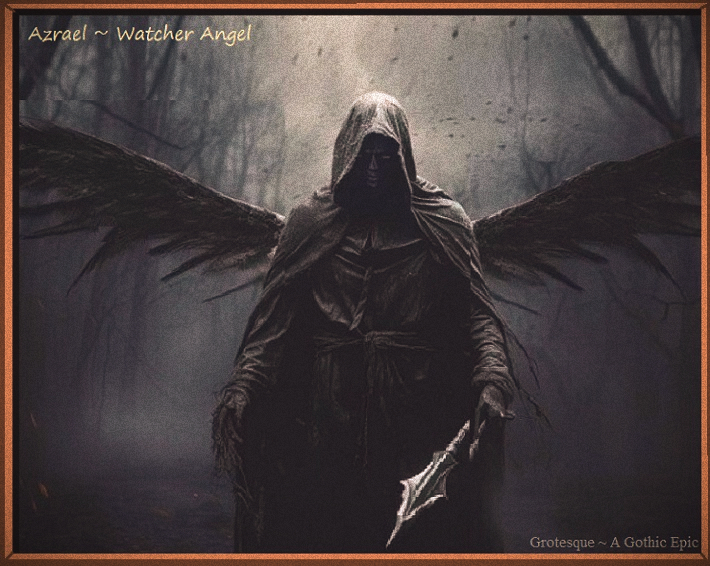
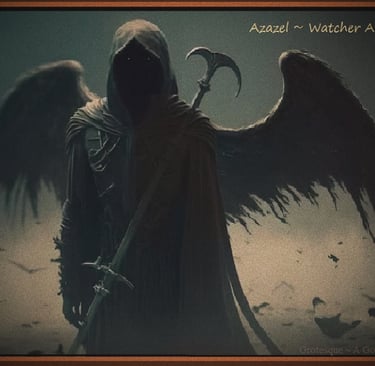
“Azrael?” Medicci laughed. “A good tracker, she is. Azrael has caught up with me several times since, apart from my regular visits to Sophia. And as always, I tell her that I am ready to go to heaven, deflect her attention, and then elude her. She does not try very hard to catch me. After all, she most likely, secretly pities my predicament. She never tells Azazal where I am, as he as never shown himself following my encounters with her. Either she pities me, or she dislikes him, or some combination thereof.”
“Azazal?” Lazarus asked.
Medicci nodded. “The other one.”
Lazarus nodded, looking squarely at him. “Indeed; what good soul would otherwise flee Heaven?” He rotated the rabbit and asked, “And what if Azrael promised to take you to hell, instead? Would you go with her as you now go with me? To fetch Sophia?”
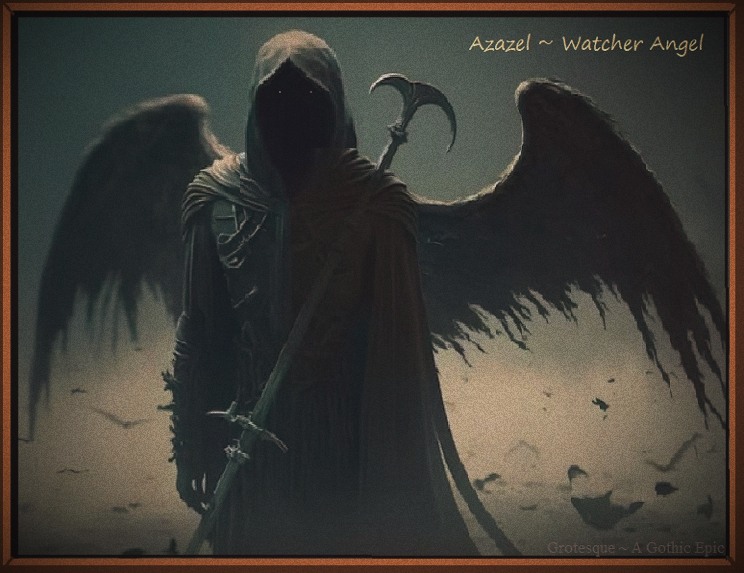
“No, Lazarus; Azrael only escorts good souls to heaven. The other angel, who Azrael and others call, Azazal, drags unwitting and wandering souls to hell. And I have had the misfortune to happen upon him only once in these many years. I barely escaped the hungry brute.”
“Why did you not accompany him to hell, instead ~ to fetch Sophia?”
“Accompany Azazal?” Medicci laughed incredulously. “One does not willingly accompany him. He snares souls and rapes them naked, much like the hare that you now hold ~ he wholly swallows them where they cannot escape. Azrael has since warned me of Azazal, saying that he is the bastard son of an Angel called Cronos, who devours all that he embraces. She made it clear, long ago, that if I do not accompany her to Heaven, that Azazal would eventually find me, devour me whole, and carry me to Hell whilst imprisoned within him.” The ghost winced. His expression hardened and he leaned toward Lazarus. “Since I roam the earth, he has every right to claim me. If he captures me, then I will not have entered hell by my own means. And I am certain that I would forever remain. That is why I have secretly sought a more acceptable entrance to hell ~ one that I might enter and escape, on my own terms.”
“To steal Sophia from hell?” Lazarus questioned.
Medicci nodded. “And I shall.”
“Can such a thing be done? I don't believe so,” Lazarus replied. “And how can you be certain that she is not in heaven ~ or that she truly is in hell? Perhaps she does as you, and only roams the earth.”
“If she walked the earth, I would have found her in the past two hundred years of my searching for a gateway to hell,” Medicci claimed, passing a pointing finger across the ocean horizon. “And Azrael has all but confessed that she is not in heaven. So, I suspect that she must be in hell.”
“What did the angel tell you?”
Medicci sighed and glanced at the beach before admitting, “Well, ‘twas not, what Azrael said, that convinced me otherwise. ‘Twas, what he did not say.”
Lazarus perked his ears. “Then, what did he not tell you?”
The ghost narrowed his eyes and shook an accusing finger at Lazarus, whispering articulately, “Every time that I ask Azrael if my Sophia is in heaven, he tells me that all things shall be revealed, when I am in heaven. And every time that I ask him if she is in hell, he only says the same.”
“So now you believe her to be in hell?” Lazarus shook his head, now thoroughly perplexed. “If the angel answered you the same, regarding her whereabouts, then why do you believe her only to be in hell, and not heaven?”
Lazarus watched Medicci stand, turn his back to him, and stare across the ocean. A steady seaward breeze blew, yet the outline of the ghost’s cape hung motionless. At length, the specter turned its head partly around and stared at the sand, appearing as though, self~absorbed in contemplation. Finally, the ghost drew a breath and nodded before turning completely around to face Lazarus. “I do not suspect my Sophia to be in hell merely by what Azrael did or did not tell me, Lazarus. There is much more to tell before you might agree with me that she is almost certainly in hell.” The apparition circled the fire, knelt beside Lazarus, and shoved a bramble deeper into the flames. Lazarus looked into the ghost’s eyes. The greenish orbs appeared distant ~ outwardly snared by the firelight; peering into perpetuity.
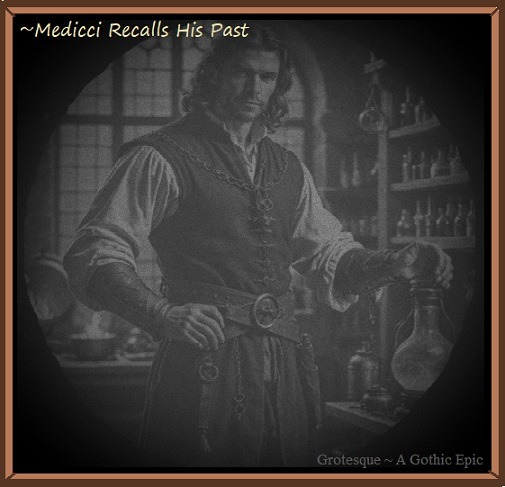
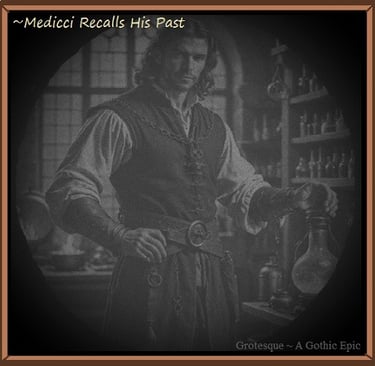
Medicci recounted his past. “By trade, I was not only a physician, but an alchemist as well. As such, I was engrossed in the discovery of exotic preparations and intoxicating prescriptions that might be administered to hinder or even prevent the most common physiological effects of aging. As my research developed, my tools and methods become evermore unconventional, and certainly contentious with the observed canons of Christendom. With that, I had no recourse but to continue my studies in secrecy, for fear of charges of heresy or sorcery. After all, I was in search of a unique and precise preparation of oils, extracts, metals, and blood salts, which might promise immortality. Indeed, I sought to formulate the very Elixir of the Ancients.”
“Does such a thing exist?” Lazarus asked.
Medicci shrugged. “It matters not ~ now. Yet, in life, I believed so.” He sighed and offered Lazarus a solemn smile. “Aside from me, only one other person remained privy to my quest. She was none other than my trusted confident and companion, Sophia.”
Lazarus nodded and politely dropped his gaze to the roasting rabbit.
The ghost reached into the heart of the fire, pulled out a glowing coal, and closely inspected it as he continued, “I was so close. I truly believed that I was on the verge of formulating the elixir.” He tossed the coal back into the flames and continued, “Nevertheless, that belief drove me to explore many strange and exotic lands, in search of the one ingredient which would energize the mixture.” The specter looked away and studied the waves before turning back to Lazarus, his mood outwardly darkened.
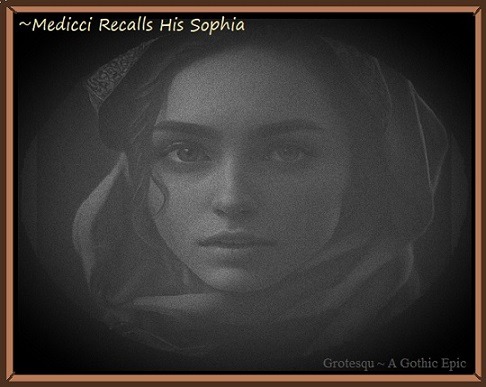
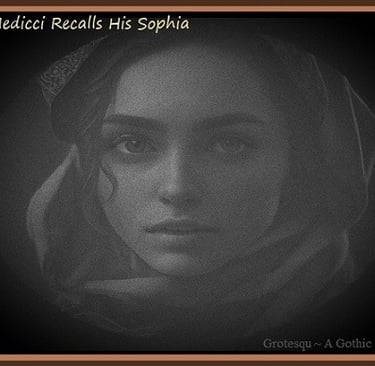
“I promised Sophia that it would be my last venture abroad. The merchant ship, upon which I booked passage, encountered a heavy storm shortly after departure. The gale battered us near to sinking and blew us well past our first port of call. Rather than turn and re~enter the storm, the Captain pressed onward and we completed the balance of our journey without incident. Alas, the belief that we had foundered in the storm, took hold, and was then confirmed when pieces of our ship, ripped from us in the tempest, washed ashore near the port that we had ignored. And false word, that all lives were lost, made its way back to my Sophia, as truth.” Although Medicci smiled and shook his head, Lazarus could see the pain on his face. “She was a passionate girl ~ foolish even. She took her own life.”
Both of them turned their attention to the rabbit and the flames that engulfed it.
“So there you have it,” Medicci remarked with a shrug. “I believe that my beloved is in hell; you know of hell’s gate; and I hope to retrieve the only heaven that I care to know.”
A moment of silence lingered betwixt them. Flames leaned in the seaward breeze, and Lazarus stared at the dim ocean horizon.
“Do you prepare your hare as a burnt offering?” Medicci asked, nodding toward the now blackened rabbit.
“Ah!” Lazarus caught himself and rescued the rabbit, holding it high on a burning stick. The breeze snuffed the flame and cooled the hare. He turned to Medicci. “If I may ask, how did you die?”
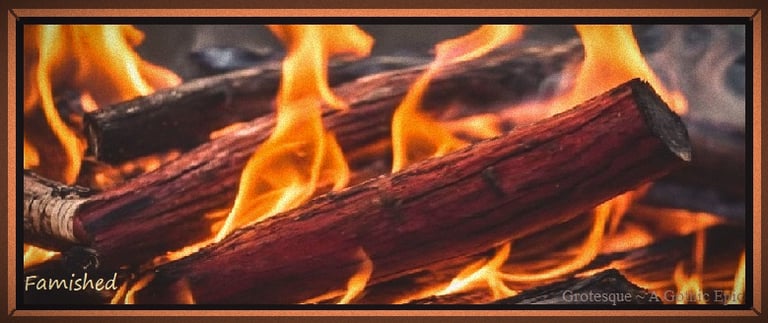
The ghost chuckled and pointed into the fire, his steady hand penetrating the flames. “From this; the very tool of my trade: our infamous Prometheus' Gift ~ FIRE. I died in my sleep.”

“You burned to death?”
“No. ‘Twas the smoke from my canisters of agents and extracts, ignited by a misplaced oil lamp ~ fatal fumes from the very ingredients which I used in my quest for the ever~elusive elixir of Life.” Medicci chuckled. “So here I am, two hundred years later.” Pausing, he added, “By chance, perhaps I discovered the elixir after all. Only, I did not know that it had to kill me in order to grant immortality.”
Lazarus narrowed his eyes, contemplating, when he burst into laughter. He quickly caught himself. “Please forgive me, Medicci.”
“Not to worry, Lazarus,” Medicci reassured him, rising to his feet, “Eat your fill and kill your pangs.” The ghost stepped away from the fire as he called back to Lazarus, “I should gather our whereabouts by name of the nearest village. I shall be but a moment.”
Lazarus watched the ghost approach the coastline. In deliberate stride, the specter inspected the lay of the stars. Then Medicci’s visage leapt into the air, and vanished.
A famished Lazarus devoured his meal as Time turned beneath a raven heaven. At length, floating embers were like trailing fireflies that swarmed from out of the coals of a dying fire; and Lazarus paced the beach, wearing an ever~tightening circular path of footprints into the sand as he scanned the skies for signs of a ghost. Yet his eyes soon fell seaward, toward the eastern horizon, and fixed on a thin red line that marked the first makings of dawn. He turned about and paced oppositely around the fire, his hands fidgeting and his eyes fixed eastward.
A voice called from over his shoulder, asking, “How do you feel?”
Lazarus spun wildly and fell back onto the sand. He watched the faint image of an approaching ghost. He glowered and stood as Medicci approached with a smile.
“Forgive me, Lazarus. I should be more forthright in my approach.”
Lazarus caught his breath and grumbled, “Yes, if you would.” He stepped quickly toward the specter, stealing a brief glimpse of the horizon before kicking sand over smoking coals and stating, “Medicci, we must leave, in haste.”
Medicci stopped before Lazarus and pointed down the coastline. “I found the village of Saint Maxime. ‘Tis but a short distance from here. It appears that you have many abilities ~ and now, with an acute sense of direction.” The ghost crossed his arms, adding, “Quite remarkable, you are. Are you certain that you have never traveled ~
“Medicci!” Lazarus interjected, thrusting a pointing finger toward the faint glow over the ocean, “It shall kill me, Medicci; I must seek shelter at once!”
“Shelter? From the ocean?”
“From the sun,” Lazarus answered, elaborating, “I have a grave illness of the sun.”
“Ah,” Medicci stated, nodding. “With extraordinary abilities come extraordinary weaknesses, as expected.” He turned and pointed inland from the beach cove. “There is a forest ~ plenty of shade, there. Shall it suffice?”
“I seek a darker place; perhaps, a cave or something of the sort.”
Medicci rubbed his chin in consideration. “I saw no cave.” He glanced at the eastern sky. “And you shan’t make it to the village before first light.” He shook his head and shrugged. “For me, it would be easy. I could hide beneath the ocean, the ground, or even within a tree. Yet you live, and must breathe.”
“I must bid you good eve,” Lazarus stated, tilting his wings and gradually banking away.
“Ah! I know of a suitable place,” Medicci exclaimed. He jabbed a finger down the southern coastline. “There is a shipwreck on the rocks, and her hull is still tightly sealed. What think you?”
“You speak the truth?”
“On my solemn word of honor ~ as a gentleman of distinction,” Medicci insisted. “I need you unharmed if I am to find my Sophia. The ship is sealed and should serve you well.”
“Will you show me?”
“Indeed ~ at once!”
Lazarus scanned the horizon. “I must fly low and quick, against land and sea.” He turned to Medicci and waved a forwarding hand to the heavens. “I should follow.”
The two of them stole into the skies, abandoning a dying fire and a blackened rabbit’s head. The discarded remains might have appeared to gawk, peering frightfully in the ascending direction of the odd pairs' departure, perhaps as to stage a final, profound, and lasting performance before an utterly absent audience ~ and in its closing moments, to lay forever still whilst staring upward, with its black and beastly, and thoroughly discarded, wide and hollow hole~of~an~eye.
Vol. I: Chap. XIX ~ finis.
Next Chapter~
~20: Jewel of Eden
“It matters not how strait the gate,
How charged with punishments the scroll,
I am the master of my fate
I am the captain of my soul.”
~W. E. Henley
Grotesque ~ A Gothic Epic © is legally and formally registered with the United States Copyright Office under title ©#TXu~1~008~517. All rights reserved 2026 by G. E. Graven. Website design and domain name owner: Susan Kelleher. Name not for resale or transfer. Strictly a humanitarian collaborative project. Although no profits are generated, current copyright prohibits duplication and redistribution. Grotesque, A Gothic Epic © is not public domain; however it is freely accessable through GothicNovel.Org (GNOrg). Access is granted only through this website for worldwide audience enjoyment. No rights available for publishing, distribution, AI representation, purchase, or transfer.